
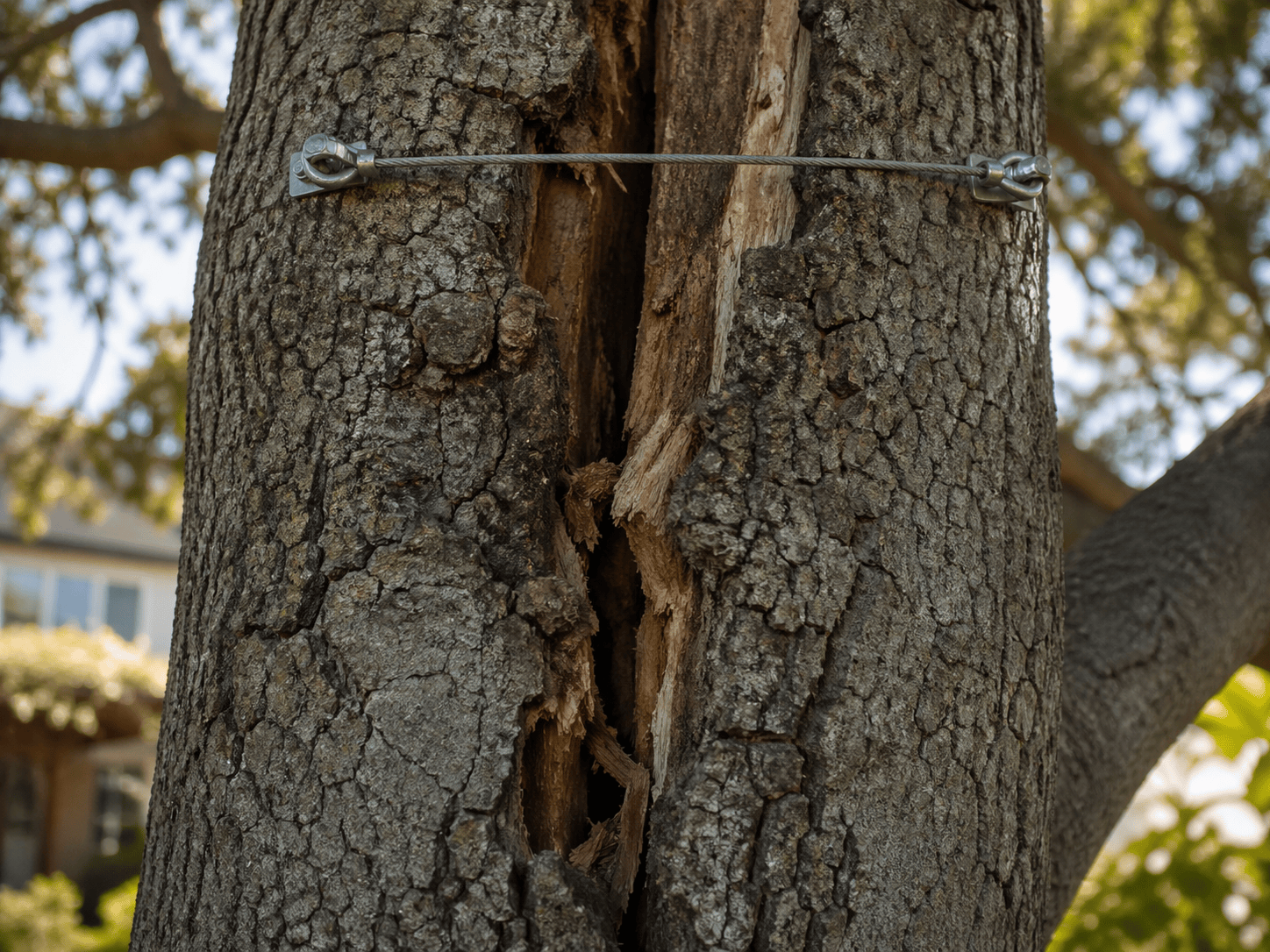
A crack running down the trunk of a mature tree means the wood has already failed somewhere along its length, and the only real question is whether what is left can carry the load. A split tree trunk can sometimes be saved with cabling and bracing if the crack is fresh, vertical, confined to one side of the trunk or a co-dominant stem union, and the wood around it is sound. A split that runs through the center of the trunk, shows decay, or runs horizontally across the grain usually means the tree should be removed.
This guide explains what to do in the first hours, how an arborist decides between repair and removal, what tree cabling and bracing actually involves, what it costs in typical ranges, and the permit and insurance details that apply in San Mateo County – from wind-exposed lots in Pacifica to the heritage oaks of Atherton and Hillsborough.
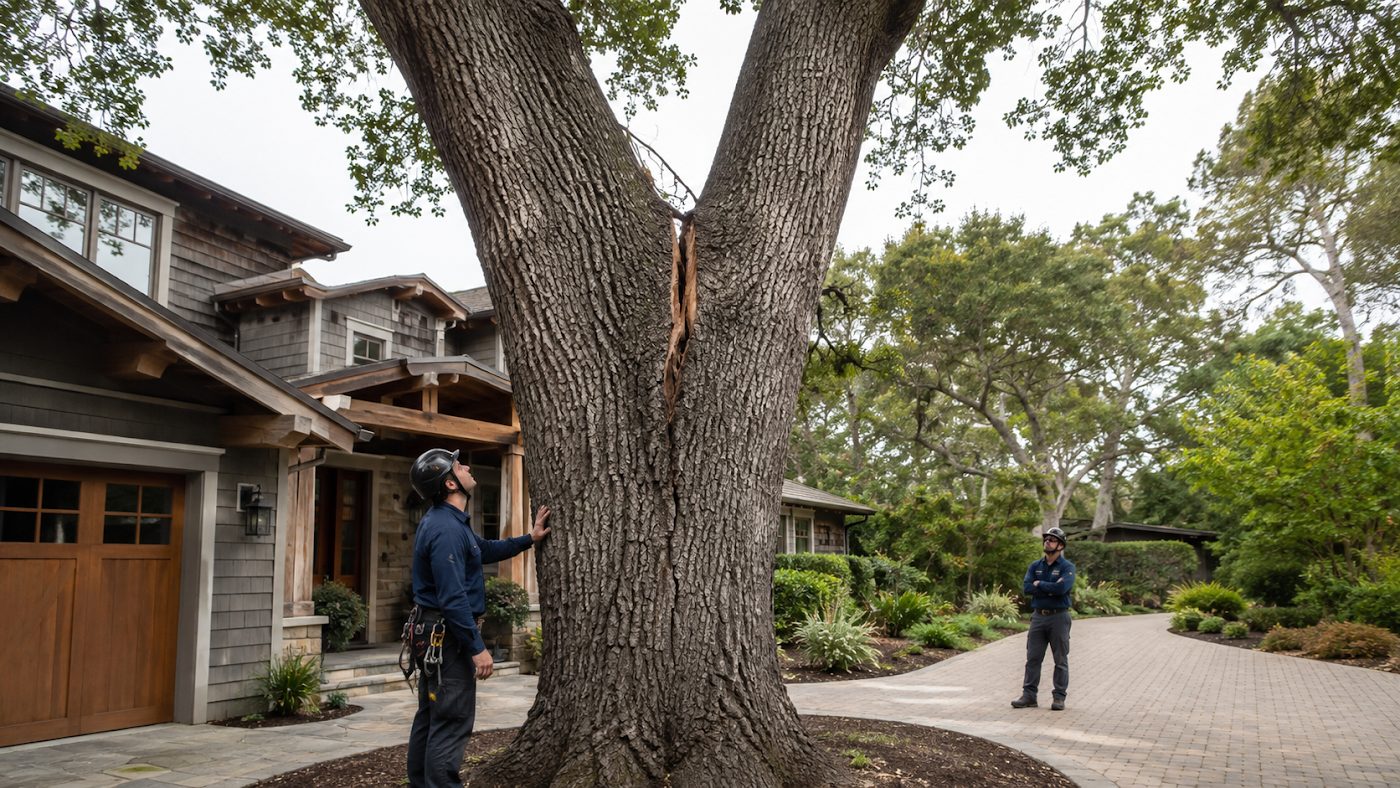
What to do right now if your tree trunk has split
A partially split trunk is a tree in active failure. Every gust off the Pacific and every hour of saturated soil adds load to the fibers that are still holding. Your job in the first hour is to keep people away from it and get a licensed arborist on the phone – not to fix anything.
- Clear the fall zone. Move cars, keep children and pets out, and stay out from under the canopy on both sides of the split. A tree that splits at a union can drop one leader in either direction.
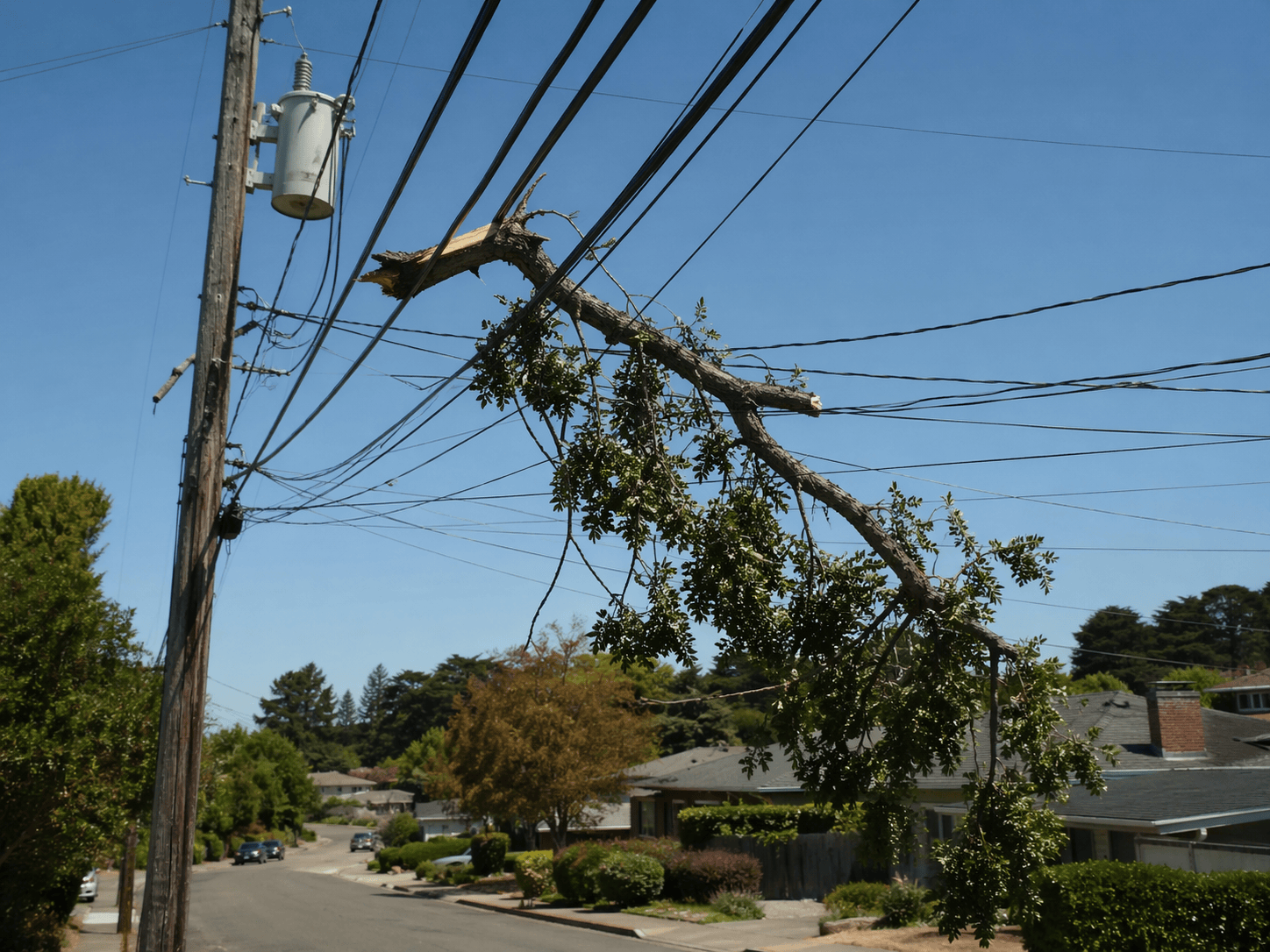
- Check for power lines. If any part of the tree touches or hangs over a line, stay back and call PG&E at 1-800-743-5000, or 911 if a line is down or sparking. Only PG&E or a PG&E-qualified line-clearance crew works near energized lines.
- Photograph it. Wide shots from several angles, then close-ups of the crack, with the date visible on your phone. These photos matter later for a permit application or an insurance file.
- Mark the area. If the tree overhangs a sidewalk, driveway, or street, cones or caution tape protect neighbors and delivery drivers until a crew arrives.
- Call a licensed arborist. Describe what you see: where the crack is, how long it is, whether the two halves move in wind, and whether anything sits underneath. That lets a crew triage urgency over the phone.
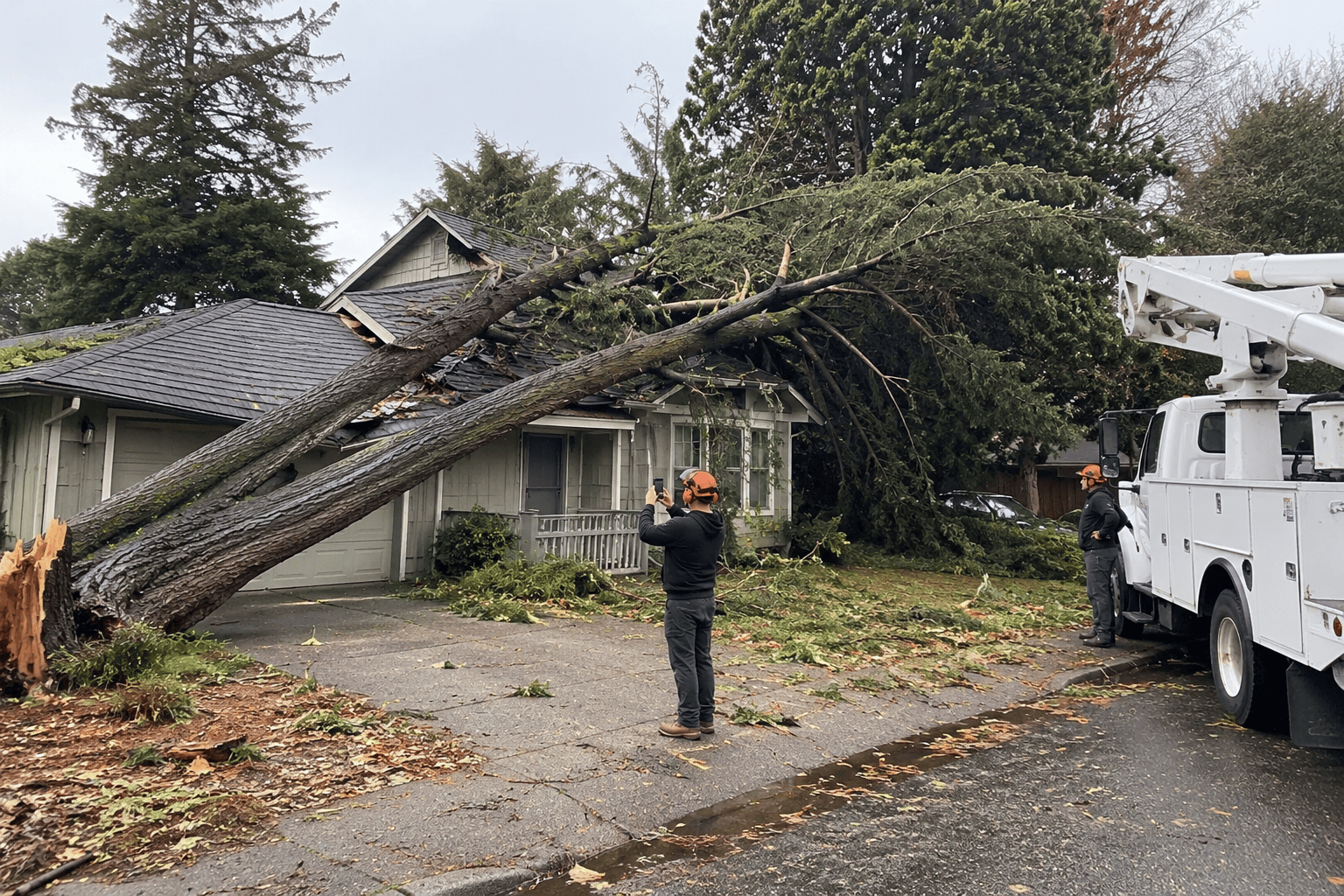
Do not try to pull the halves together with rope, a ratchet strap, or a vehicle, and do not cut into the trunk. A split trunk stores enormous tension, and releasing it the wrong way is how the remaining wood snaps. If the tree is leaning toward a house or a road, treat it as an emergency and call our 24/7 emergency tree service line.
Can a split tree trunk be saved?
Yes, some can. Trees do not heal cracks the way skin heals a cut – they wall off (compartmentalize) the damage and grow new wood around it. Stabilization hardware buys the tree the years it needs to do that. Whether that is realistic depends on five things our arborist checks on site.
Where the split is
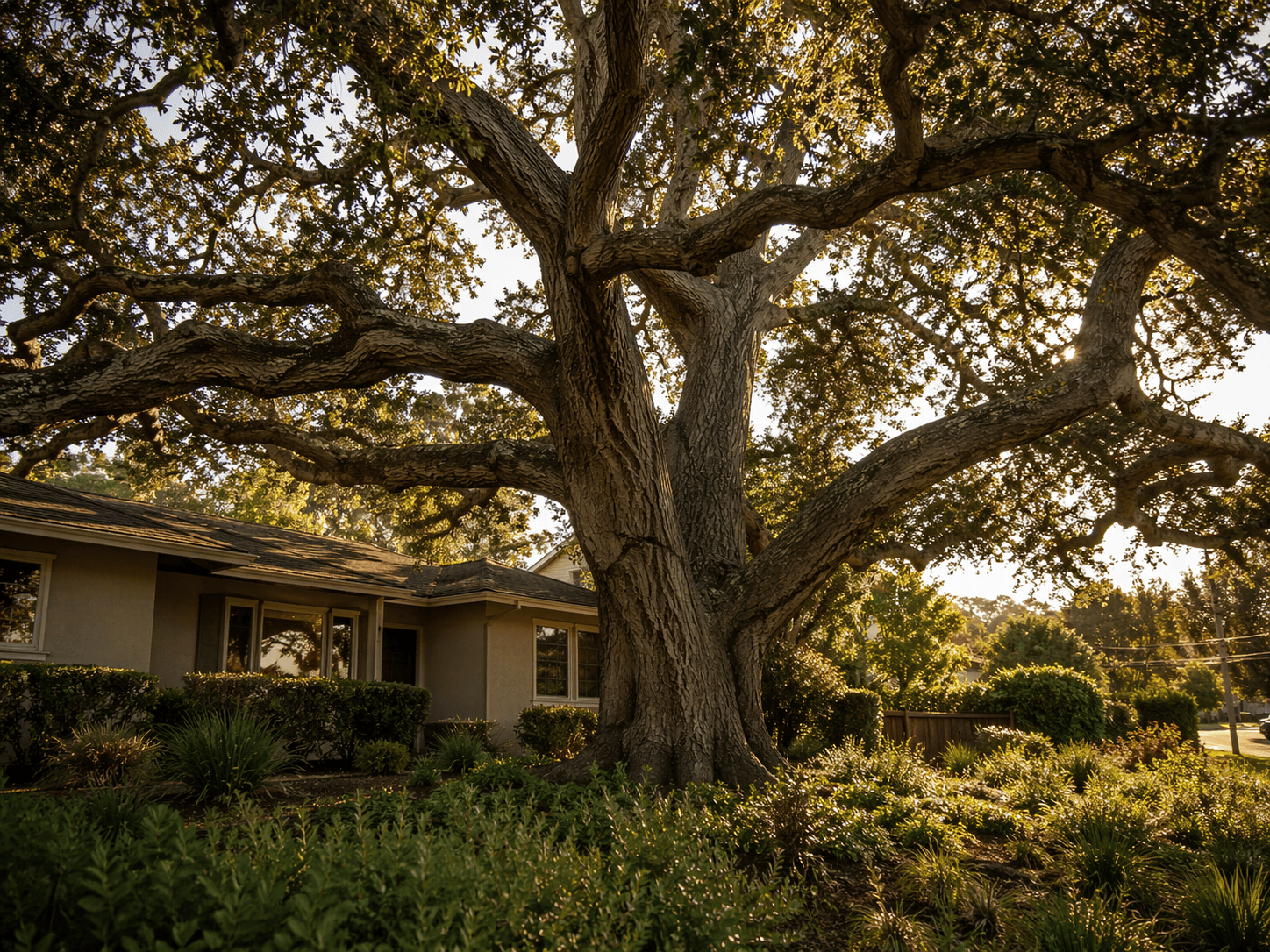
The most repairable split on Peninsula properties is a fresh crack at a co-dominant stem union – two trunks of similar size rising from one point. Most of those unions hide included bark, a seam of bark trapped between the stems that never fused into solid wood. Rods through the union and a cable higher in the canopy can hold that joint for decades. A split that starts at the ground and runs up through the pith of a single trunk is a different problem and is rarely worth bracing.
How much of the cross-section is gone
A crack confined to one side of the trunk, with most of the circumference still sound, is a candidate for repair. When the crack runs through the center and both halves flex independently in wind, the trunk has effectively become two cantilevers, and hardware alone will not make it one tree again.
Direction of the crack
Vertical cracks that follow the grain are the ones arborists can work with. Horizontal or diagonal fractures cut across the load-bearing fibers and almost always mean the tree has already failed structurally, even if it is still standing.
Decay, cavities, and fungal brackets
Discolored, soft, or hollow wood inside the crack, conks (fungal brackets) on the trunk, or carpenter ants streaming out of the split all point to a tree that was weak before the storm. Hardware bolted into decayed wood has nothing to hold onto. If you have seen insect activity, our guide to termites and ants in a tree explains what the signs mean.
Species and what stands beneath it
Coast live oak, valley oak, and other dense hardwoods compartmentalize well and are often worth the investment. Monterey pine, Monterey cypress, eucalyptus, acacia, and fast-grown ornamentals compartmentalize poorly and tend to fail again at the repair. Just as important is the target: a braced tree in an open meadow in La Honda carries a very different risk than the same tree over a bedroom in Menlo Park.

Repair or remove: the decision table
Every tree gets an individual assessment, but the pattern below is how most split-trunk calls in San Mateo County resolve.
| What we find | Usual recommendation | Why |
|---|---|---|
| Fresh vertical crack at a co-dominant union, sound wood, healthy crown | Brace rods plus a cable, with weight reduction | The union can be held together while the tree compartmentalizes the wound |
| Long vertical crack on one side of a single trunk, no decay | Case by case – often bracing plus crown reduction, re-inspected yearly | Depends on how much sound wood remains and what the tree could hit |
| Crack through the center, halves move independently in wind | Removal | The trunk is no longer one structural member; hardware cannot restore that |
| Horizontal or diagonal fracture across the grain | Removal, usually same day | Load-bearing fibers are severed; failure is a matter of time |
| Any crack with decay, cavities, fungal brackets, or a lean that is increasing | Removal | Hardware needs sound wood to anchor into; a moving lean means the roots are involved |
| Split limb or leader that can be removed while leaving a balanced tree | Remove the damaged part, keep the tree | Often the best outcome for a mature oak with one failed leader |
The International Society of Arboriculture (ISA) is candid about what support hardware can and cannot do, and we repeat it to every client who wants to keep a split tree:
“If branches or tree trunks need additional support, a professional arborist may be able to install cables or bracing rods. The amount of added security offered by the installation of support hardware is limited.”
– International Society of Arboriculture, TreesAreGood.org, “Managing Hazards and Risk”
That is why a TRAQ (Tree Risk Assessment Qualification) rating comes first. It weighs the likelihood of failure, the likelihood of hitting something, and the consequences if it does. A “moderate” tree in an empty side yard may be a good bracing candidate; the same tree rated “high” over a garage in Burlingame is not.
What causes a tree trunk to split vertically?
Most split trunks on the Peninsula were built to fail years before the storm that finished the job. The usual causes we document in reports:
- Included bark at co-dominant unions. The single most common cause in mature oaks, elms, and ornamental pears. The bark seam is a built-in crack waiting for load.
- Wind loading. Coastside lots in Pacifica, Montara, El Granada, and Half Moon Bay take sustained onshore wind, and trees there grow lopsided crowns that lever against weak unions. Winter atmospheric-river storms add wet, heavy canopies on saturated soil.
- Long, end-heavy limbs. A horizontal limb over a roof acts as a lever on the trunk every time it moves. Our post on a hanging tree branch over the roof covers that failure pattern in detail.
- Topping and over-pruning. Topped trees throw up dense, weakly attached regrowth that is heavy at the ends and rots at the old cuts. Splits at those stubs are common a decade later; see how to fix a topped tree.
- Root and soil problems. Root cutting for a driveway or sewer lateral, grade changes, and chronic overwatering of native oaks all weaken the base and shift load into the trunk.
- Lightning and frost cracks. Both are rare in San Mateo County compared with the Midwest, but we do see them on ridge-top trees in Woodside-adjacent La Honda and Skyline.
How tree cabling and bracing works
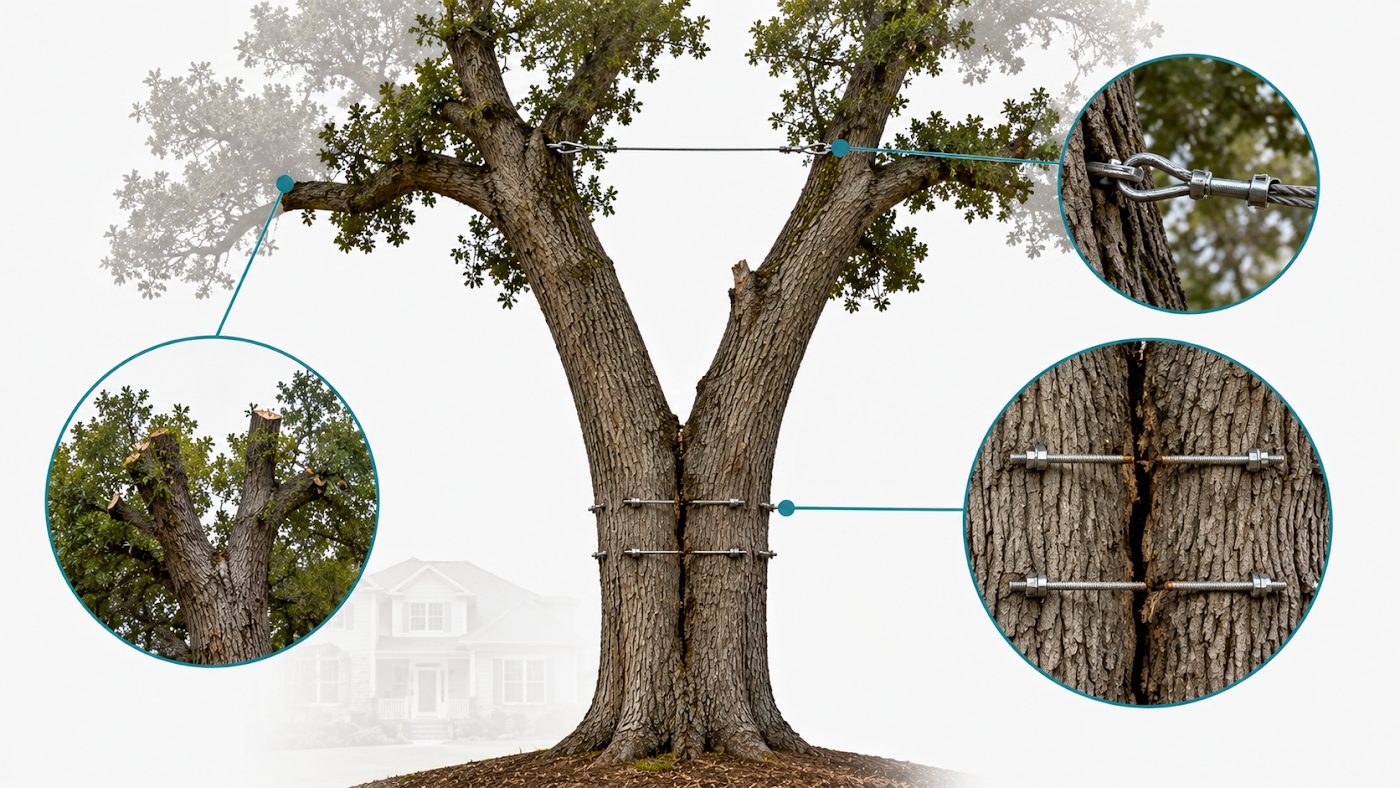
Cabling and bracing is not a repair of the wood itself. It is a support system that limits movement at the weak point so the tree can grow reaction wood around it. Installed correctly, to the ANSI A300 (Part 3) support-systems standard, it is a long-term risk-management tool, not a one-time fix.
Brace rods
Threaded steel rods are installed through the trunk at and just above the split, with washers and nuts on each side. They pin the two halves so the crack cannot open further. Rod size and count depend on trunk diameter; a large oak may need two or three rods spaced along the union.
Cables
Static (steel) or dynamic (synthetic) cables are set high in the canopy, typically about two-thirds of the way from the union to the top of the leaders. They share the load between stems so wind on one leader is resisted by the other, instead of by the damaged union alone.
Weight reduction
Nearly every bracing job includes a crown reduction to cut end-weight on the leaders that are pulling the union apart. On native oaks we schedule that pruning for the dry season, since wet-season cuts invite disease; our guide to when not to prune oaks in California explains the timing.
Re-inspection
Hardware needs to be checked. We recommend an inspection after the first major storm and then on a regular cycle, looking at cable tension, corrosion, and whether the tree is growing over the rods cleanly or forming decay around them. A braced tree is a managed tree for the rest of its life.
What repair or removal costs in San Mateo County
Cabling and bracing is priced by the tree: trunk diameter, number of rods, cable span, how much pruning is needed, and access. We give a written figure after seeing the tree rather than quoting hardware over the phone. Removal follows the same typical ranges as any other job: a small tree typically runs about $300-$600, and a large or hazardous removal $1,000-$3,000 or more, depending on size, location, and rigging. Every estimate includes removal, dumping, and hauling – no callbacks for extra charges.
Two things change the math on a split tree. First, a split trunk over a structure often has to come down in small pieces with rigging or from the aerial lift, which is why it sits at the hazardous end of the range. Second, if the tree is coming out, stump grinding bundled with the removal costs less than a separate visit. Estimates are free, and there are no hidden fees.
Permits for a split tree in San Mateo County
A split trunk does not automatically waive the permit rules. Most cities in the county regulate removal of trees above a set trunk size or of protected species – native oaks and redwoods in Palo Alto, heritage trees in Menlo Park and Atherton, and similar ordinances in Hillsborough, Redwood City, Burlingame, and San Mateo. The thresholds differ by city, so check with your city or ask our arborist rather than assuming.
What most ordinances share is an emergency provision: a tree that presents an immediate hazard can be removed first, with documentation filed promptly afterward. That documentation is where your day-one photos and a written arborist statement come in. If you have time, apply before the work; if the tree is actively failing, we document the condition, do the work, and prepare the paperwork the city will ask for. Our post on protected trees in San Mateo covers how the process runs and how to avoid fines.
Insurance: what a split tree usually does and does not cover
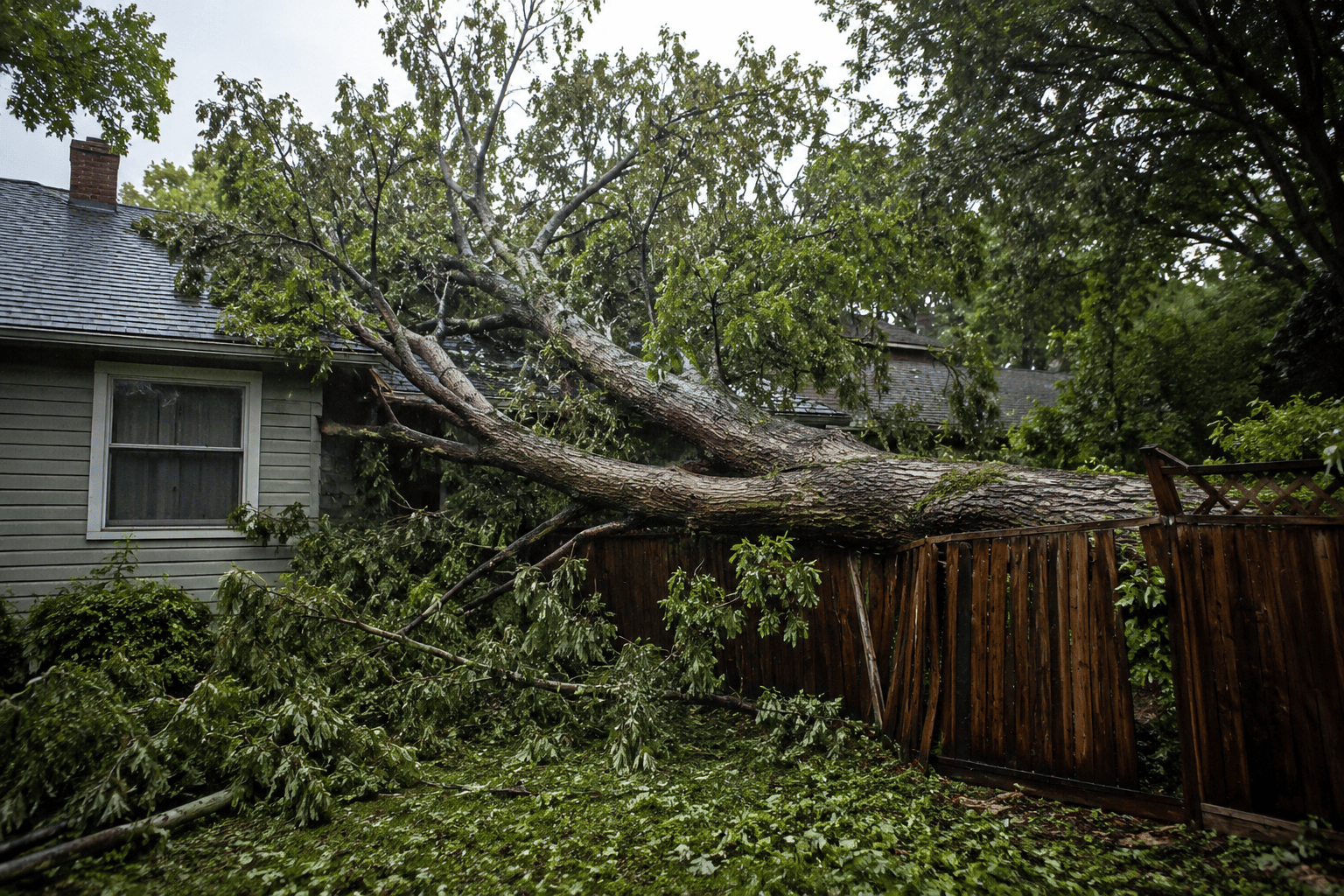
Homeowner policies in California generally treat cabling and bracing as maintenance, and they rarely pay to remove a standing tree just because it has cracked. Coverage normally starts when the tree, or part of it, lands on a covered structure. Policies vary – confirm with your insurer – but the practical advice is the same either way: document the split now. If a braced or scheduled-for-removal tree fails in the next storm, the dated photos and a written arborist report show you acted reasonably. Our guide to fallen-tree insurance claim photos and documents lists exactly what adjusters ask for, and if the worst happens, what to do when a tree falls on the house walks through the first 24 hours.

Preventing the next split
- Structural pruning while trees are young establishes a single leader and removes co-dominant stems before they become a 30-inch union with included bark.
- Crown reduction on mature trees with long, end-heavy limbs, especially on coastside lots where wind never stops.
- Preventive cabling on valuable trees with known weak unions – far cheaper than removal after failure, and far cheaper than a roof.
- Protect the roots. Keep trenching, grading, and summer irrigation away from native oaks.
- Inspect after every big storm. Walk the property and look at unions, the root flare, and any new lean. A licensed arborist visit every year or two catches what you will not see from the ground.
How Precision Tree Care handles a cracked or split trunk
Our ISA Certified Arborist inspects the tree in person: the crack, the union, the wood inside the split, the root flare, the species, and everything in the fall zone. Where the tree is worth keeping, we give a TRAQ-based risk rating and a written plan: rod and cable specification, the weight reduction that goes with it, and the re-inspection schedule. Where it is not, we say so plainly and give a written removal estimate with the permit paperwork the city will want.
For the work itself, our crew uses the tools the site calls for: technical climbing and rigging to lower sections piece by piece when a lift cannot reach, aerial lifts up to 75 ft for trees over roofs and driveways, and stump grinders sized to the job if the tree comes out. Everything is chipped and hauled the same day. We leave your property spotless – no debris, no mess, no worries. Free wood chips are available upon request.
Precision Tree Care has served San Mateo County since 2005, backed by 40+ years of family expertise. Our work is led by an ISA Certified Arborist (#WE-12520A), we hold California Contractors License #907593, and we carry full liability and workers’ compensation insurance – so a permit office, an insurer, or an HOA can rely on our documentation.
Split or cracked trunk? Get a straight answer on brace vs remove.
Our arborist will inspect the tree, give you a written recommendation, and quote the work. Free estimates, no hidden fees – removal, dumping and hauling are included.
Request a Free Estimate
or call (650) 355-1277 – 24/7 for emergencies
Frequently asked questions
Can a tree with a split trunk survive?
Yes, if the split is fresh, vertical, confined to one side of the trunk or a co-dominant union, and the surrounding wood is sound. An arborist can install brace rods and a cable so the tree walls off the wound over several years. Splits through the center, horizontal fractures, or any crack with decay generally mean the tree will not be safe to keep.
Can a split tree heal itself?
Not in the way a cut heals. Trees compartmentalize damage: they seal the wound off and grow new wood around it, but the crack itself never knits back together. A small bark split on a healthy tree may close over on its own. A structural split in the trunk needs support hardware to stop it from opening further while the tree grows reaction wood.
How do you fix a split in a tree trunk?
A licensed arborist installs threaded brace rods through the trunk at the split, adds a support cable high in the canopy to share load between the leaders, and reduces end-weight with careful pruning. The hardware is then inspected on a schedule. Pulling the halves together with rope or straps, or cutting into the trunk, is unsafe and usually makes the failure worse.
What causes a tree trunk to split vertically?
The most common cause is included bark at a co-dominant stem union, which never fuses into solid wood and splits under wind or the weight of a wet canopy. Long end-heavy limbs, topping, root damage, and saturated soil during winter storms add load. On the San Mateo County coast, constant onshore wind and lopsided crowns make unions fail sooner.
Is tree cabling and bracing permanent?
No. Cabling and bracing is long-term risk management, not a one-time fix. Hardware is installed to the ANSI A300 support-systems standard and must be re-inspected on a regular cycle for tension, corrosion, and decay around the rods. The ISA notes that the added security from support hardware is limited, which is why a risk assessment comes first.
Do I need a permit to remove a split tree in San Mateo County?
Often, yes. Most cities in the county regulate removal of protected or heritage trees by species and trunk size, and thresholds differ by city. Most ordinances allow an immediate hazard to be removed first with documentation filed afterward: dated photos and a written arborist statement. Check with your city or ask our arborist before non-emergency work.
Will insurance pay to brace or remove a cracked tree?
Usually not for a standing tree. Cabling and bracing is treated as maintenance, and removal is normally covered only after the tree damages a covered structure. Policies vary, so confirm with your insurer. Either way, document the split with dated photos and a written arborist report so you can show you acted reasonably if the tree later fails.
How much does it cost to brace or remove a split tree?
Cabling and bracing is quoted per tree after inspection, based on trunk size, hardware, pruning, and access. Removal follows typical ranges: about $300-$600 for a small tree and $1,000-$3,000 or more for a large or hazardous one, with removal, dumping, and hauling included. Estimates from Precision Tree Care are free – call (650) 355-1277.