

A step-by-step guide for Bay Area homeowners: how to stay safe, protect your property, and handle insurance – before the tree service arrives.
First 30 Minutes: What to Do Right Now
If a tree just fell or is about to, these steps matter more than anything else in this article. Do them in order.
1. Get everyone away
Move family, pets, and neighbors out of the area immediately. Stay at least twice the tree’s height away in all directions. Fallen trees shift without warning – branches under tension can spring loose, and a partially standing trunk can come down at any moment. Keep children and pets inside until the area is secured.
2. Look for power lines
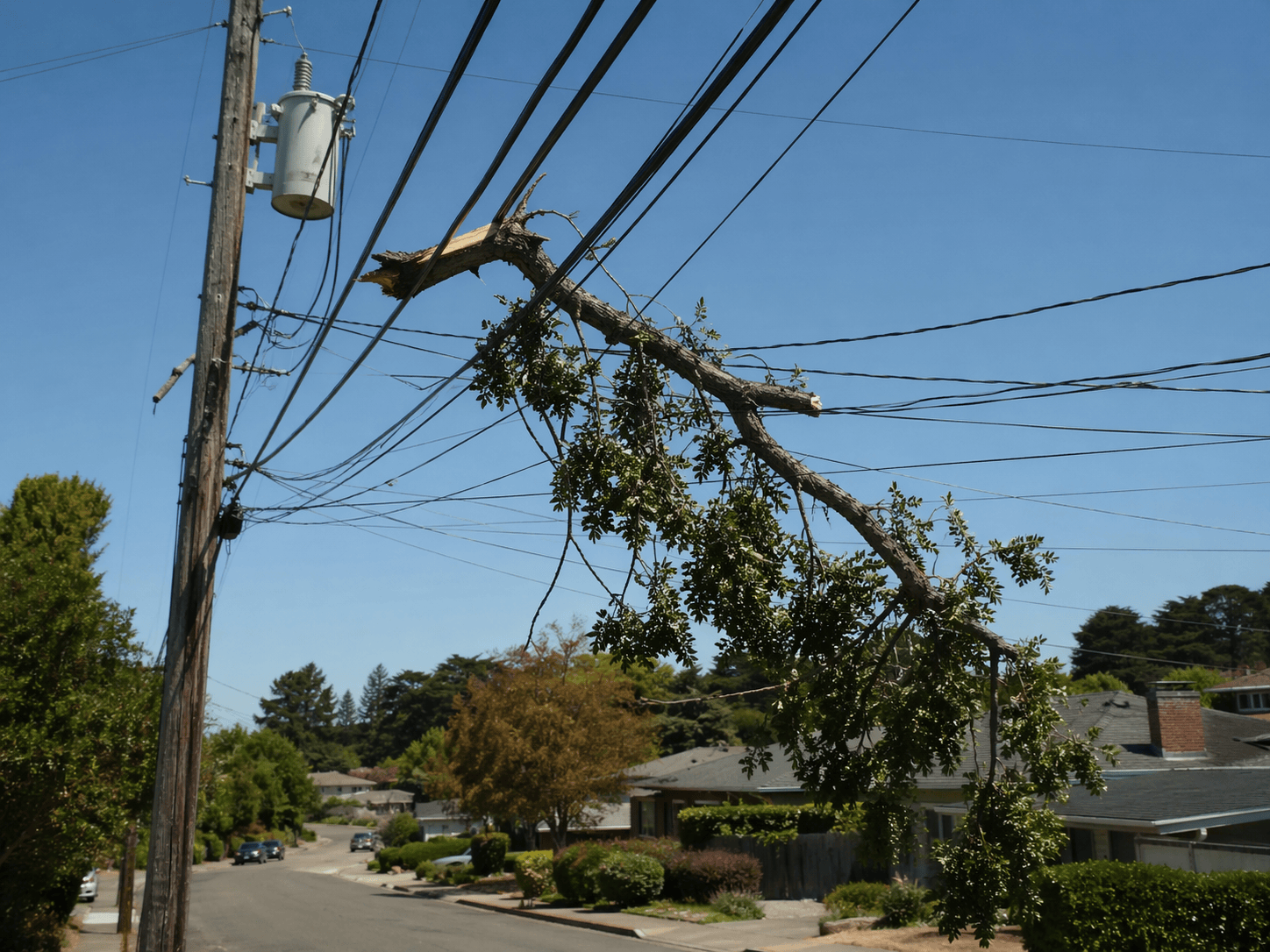
Before you do anything else, scan the area for wires. If you see any lines — even if they look intact or disconnected – call 911 and PG&E immediately. Stay at least 30 feet away. Power lines can arc electricity through the air without direct contact, and a tree touching a live wire turns the entire trunk into a conductor.
Warning signs of electrical danger: sparking or buzzing sounds, burning smell, flickering lights in nearby homes, or a tingling feeling in the ground. If someone is in contact with an electrified tree, do not touch them – call 911 and wait for responders.
3. Document everything
Once you’ve confirmed there are no electrical hazards:
- Photograph from multiple angles – wide shots of the full scene, then close-ups of damage to structures, vehicles, fences.
- Record a short video walkthrough narrating what happened and when.
- Note the time, weather conditions, and sequence of events.
- Don’t move anything. Insurance adjusters need to see the scene as it happened. Moving debris before documentation can complicate or sink your claim.
4. Call a professional tree service
Don’t wait for Monday or business hours. A tree that’s fallen or hanging can collapse further, causing additional damage with every hour. When you call, have ready: your address, whether power lines are involved, whether anyone is injured, and whether the tree is on a structure or blocking access.
5. Call your insurance company
Most homeowner’s policies cover emergency tree removal when the tree has damaged a structure or is blocking necessary access (like your driveway or a public road). Ask your adjuster these specific questions:
- Is emergency removal covered, and is there a deductible?
- Can you choose your own contractor, or do they require a preferred vendor?
- What documentation do they need – and by when?
A reputable tree company will provide detailed reports and photos that support your claim. Some will work directly with your adjuster.
6. Secure the area
If you can do it safely without approaching the tree: put up cones or tape, keep vehicles away, cover exposed areas of your home with tarps, and shut off gas or water if lines may be damaged.
What Counts as a Tree Emergency
Not every tree problem is urgent. A slow lean that’s been there for years or a few dead branches in the canopy — those need attention, but not tonight. These situations are different:
- Fallen or partially collapsed trees — even if they look stable, the weight can shift without warning.
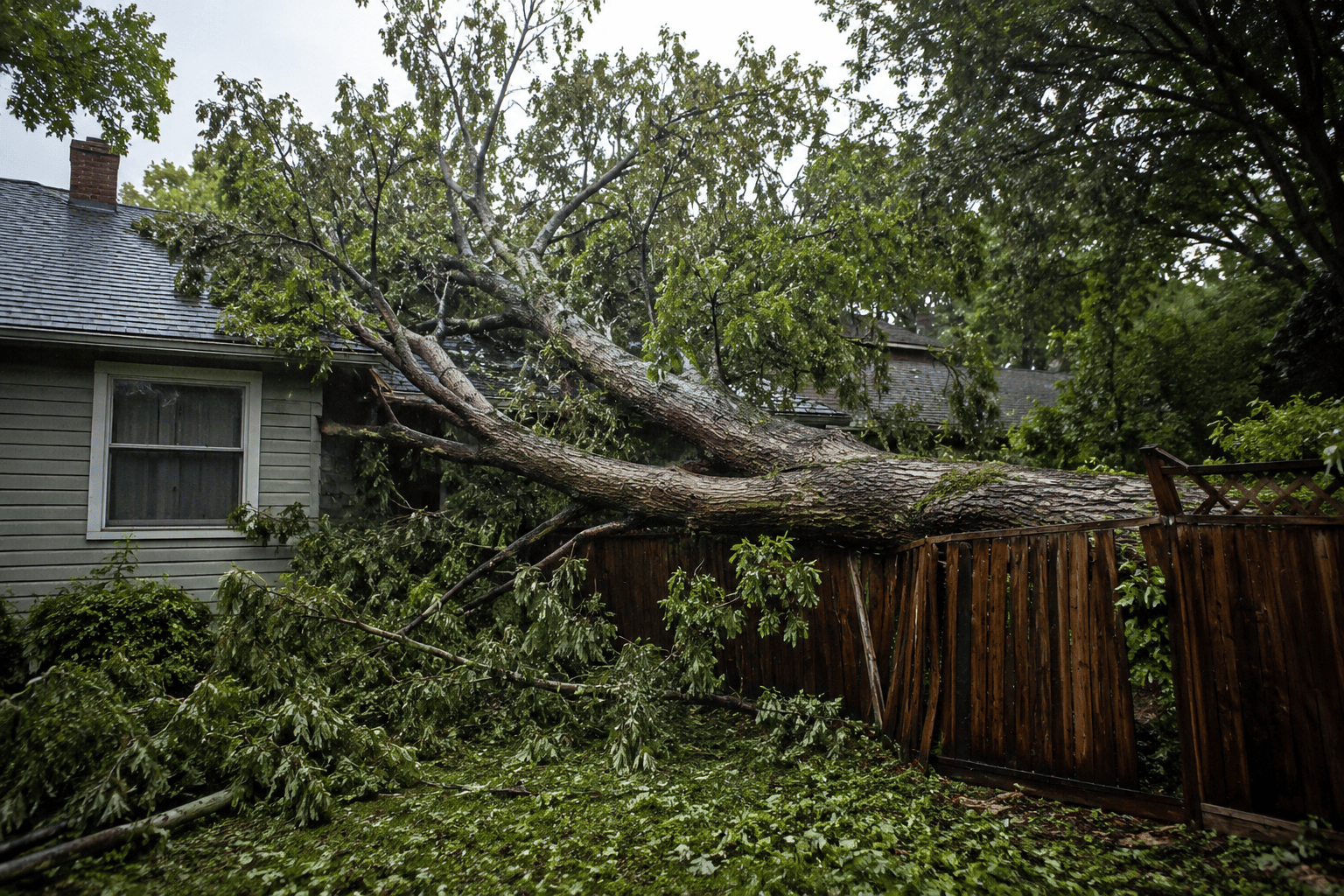
- Trees resting on structures — weight distribution changes with temperature, wind, and settling. Damage gets worse by the hour.
- Sudden lean after a storm — this means root failure. The tree can go down in any direction without further warning.
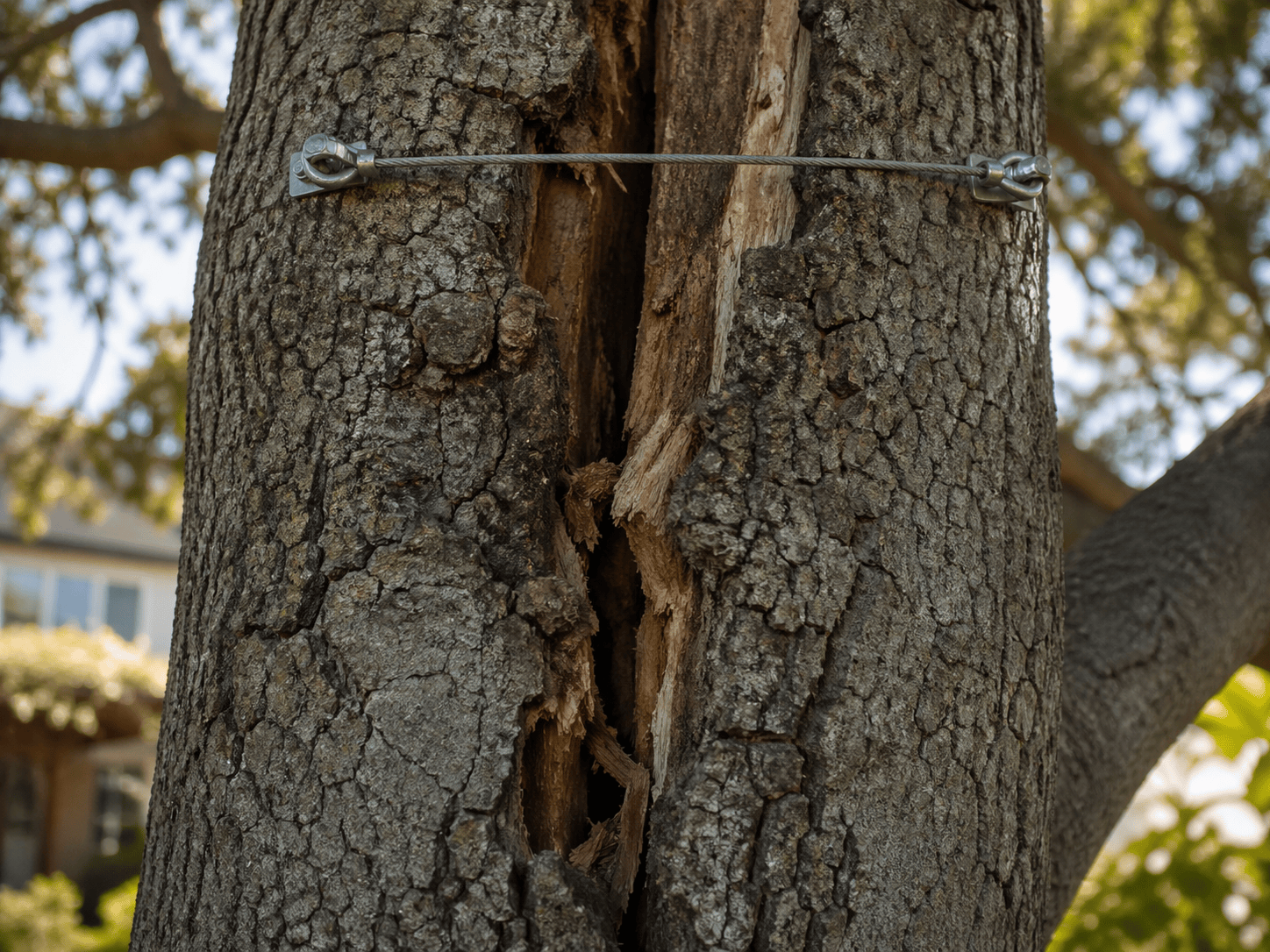
- Cracked or split trunks — a vertical crack in the main trunk is structural failure. The tree can no longer hold its own weight.
- Hanging limbs (“widow makers”) — large branches caught in the canopy can fall days or weeks later, often on calm days when no one expects it.
- Trees on or near power lines — the most dangerous scenario. Never approach. Call 911 first.
If you’re unsure whether your situation is urgent, treat it as urgent. It’s always cheaper to call and find out it can wait than to wait and find out it couldn’t.
Why You Shouldn’t Remove a Fallen Tree Yourself
Tree work has one of the highest fatality rates of any profession in the United States — and that’s among trained professionals with proper equipment. For a homeowner with a ladder and a hardware-store chainsaw, the risks multiply.
The core problem is physics. A fallen tree has unpredictable weight distribution and hidden tension points throughout its structure. One wrong cut can release thousands of pounds of stored energy, sending wood in directions you didn’t expect. People cause tens of thousands in additional property damage every year trying to save a few thousand on professional removal.
There’s also the liability issue. If you hire an unlicensed worker and they get injured on your property, you can be held responsible for medical costs, lost wages, and disability. Licensed tree services carry $2–5 million in liability insurance and workers’ comp. Your homeowner’s policy almost certainly doesn’t cover DIY tree work injuries.
Professional crews bring cranes, rigging systems, commercial chainsaws, and — most importantly — the training to read how a tree will move before they make each cut. That expertise is what you’re paying for.
How to Prevent Tree Emergencies
Most tree failures don’t happen out of nowhere. They develop over months or years, and a trained eye can spot them early. Here’s what actually works:
Annual inspections
An ISA-certified arborist can identify structural defects, internal decay, root problems, and disease years before they become emergencies. In the Bay Area, they’ll specifically check for sudden oak death, pitch canker in pines, and root rot in redwoods — all common local threats. A comprehensive inspection runs $150–400, compared to $5,000–15,000 for emergency removal.
Regular pruning
Professional pruning every 3–5 years removes dead wood (always the first thing to fail in storms), reduces wind resistance by thinning the crown, and eliminates weak branch unions before they become problems. Fast-growing species or trees near structures may need annual attention.
Cabling and bracing
For structurally compromised trees worth preserving — historic specimens, trees with sentimental value, or large trees that would be expensive to replace — steel cables and bracing rods add structural support. These systems need re-inspection every 2–3 years.
About Precision Tree Care Inc.
We’re a locally owned tree service based in Pacifica, serving San Mateo County, San Francisco, and the Mid-Peninsula. Licensed, insured, and bonded, with ISA-certified arborists on staff and over 40 years of combined experience.
Emergency response
We answer calls 24/7, including nights, weekends, and holidays. For emergencies, we’re typically on-site within 2–4 hours. We handle everything from initial assessment through complete removal and cleanup, and provide full documentation for your insurance claim.
What we bring
| Equipment | Purpose |
|---|---|
| Cranes | Controlled removal of large sections over structures |
| Rigging systems | Precision lowering of heavy limbs in tight spaces |
| Commercial chainsaws | Rated for emergency-grade cutting |
| Stump grinders | Deep grinding to below grade |
| Industrial chippers | On-site debris processing and removal |
All costs — hauling, dump fees, and cleanup — are included in your estimate. No hidden charges.
Service area
San Francisco, San Mateo, Redwood City, Menlo Park, Burlingame, San Carlos, Daly City, South San Francisco, Millbrae, Foster City, Pacifica, and throughout San Mateo County.
Get Help Now
Tree down? Dangerous lean? Hanging limbs over your roof? Call or text any time — we answer 24/7.