
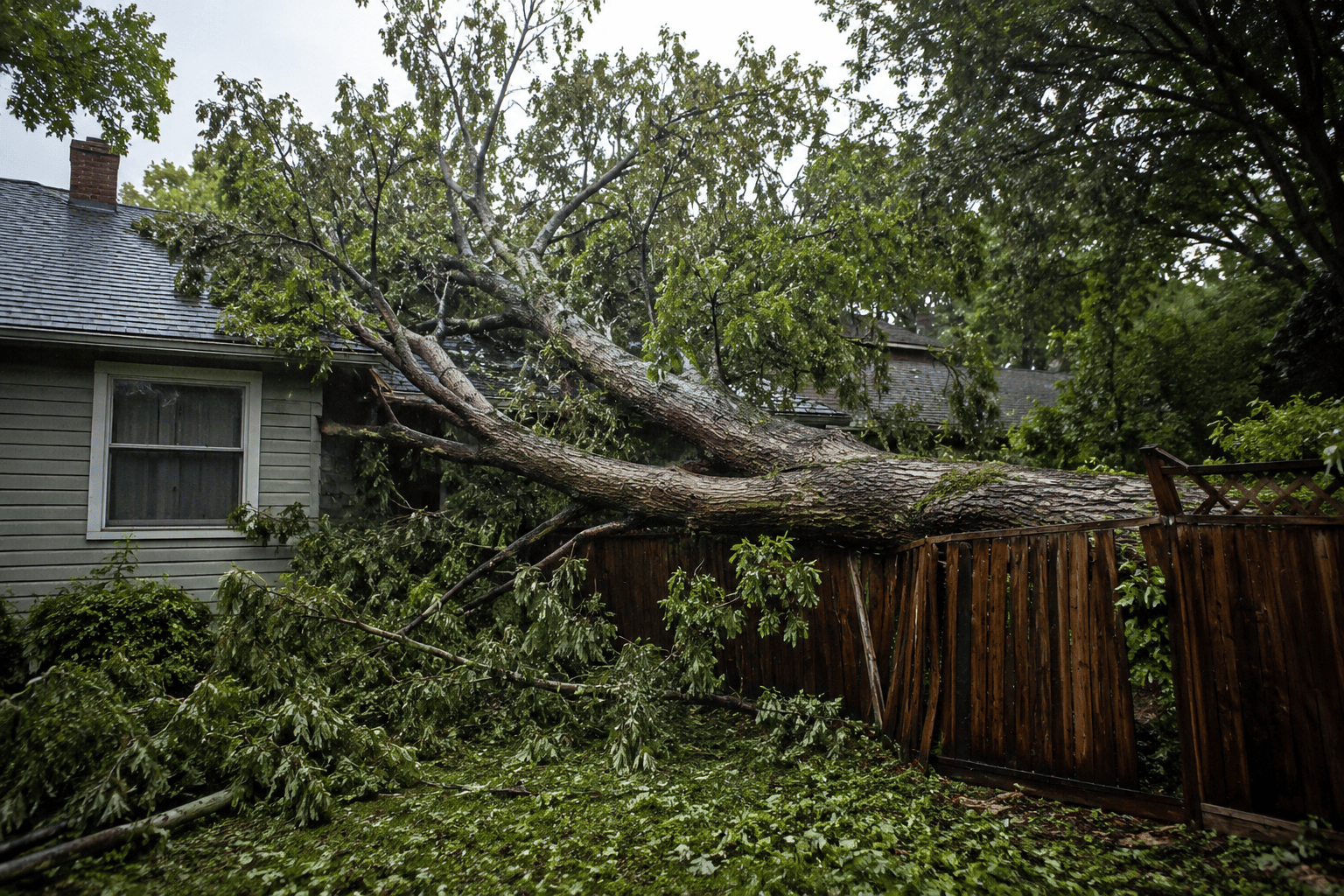
A neighbor’s tree came down in your yard, on your fence, or onto your roof, and the first question after “is everyone okay” is “who pays for this?” In California, when a neighbor’s tree falls on your property because of wind, rain, or saturated soil, your own homeowner’s insurance usually pays for your damage – the neighbor is only responsible if you can show they knew, or should have known, the tree was dead, diseased, or unstable and did nothing about it. Under California Civil Code section 833, a tree belongs to whoever owns the land its trunk stands on, so the tree is theirs, but ownership alone does not make them liable for an act of nature.
This guide walks through what to do in the first hours, how California’s negligence rule works in practice, what your insurer will and will not cover, how much of an overhanging tree you may legally trim, and why a written arborist report documenting pre-existing decay is the single piece of evidence that decides most neighbor-tree claims in San Mateo County. This is general information, not legal advice – for a dispute that involves real money, talk to a California attorney.

What to do in the first hour
The order is safety, then documentation, then phone calls. Nothing you do in the first hour changes who pays – but skipping the documentation step can cost you the argument later.
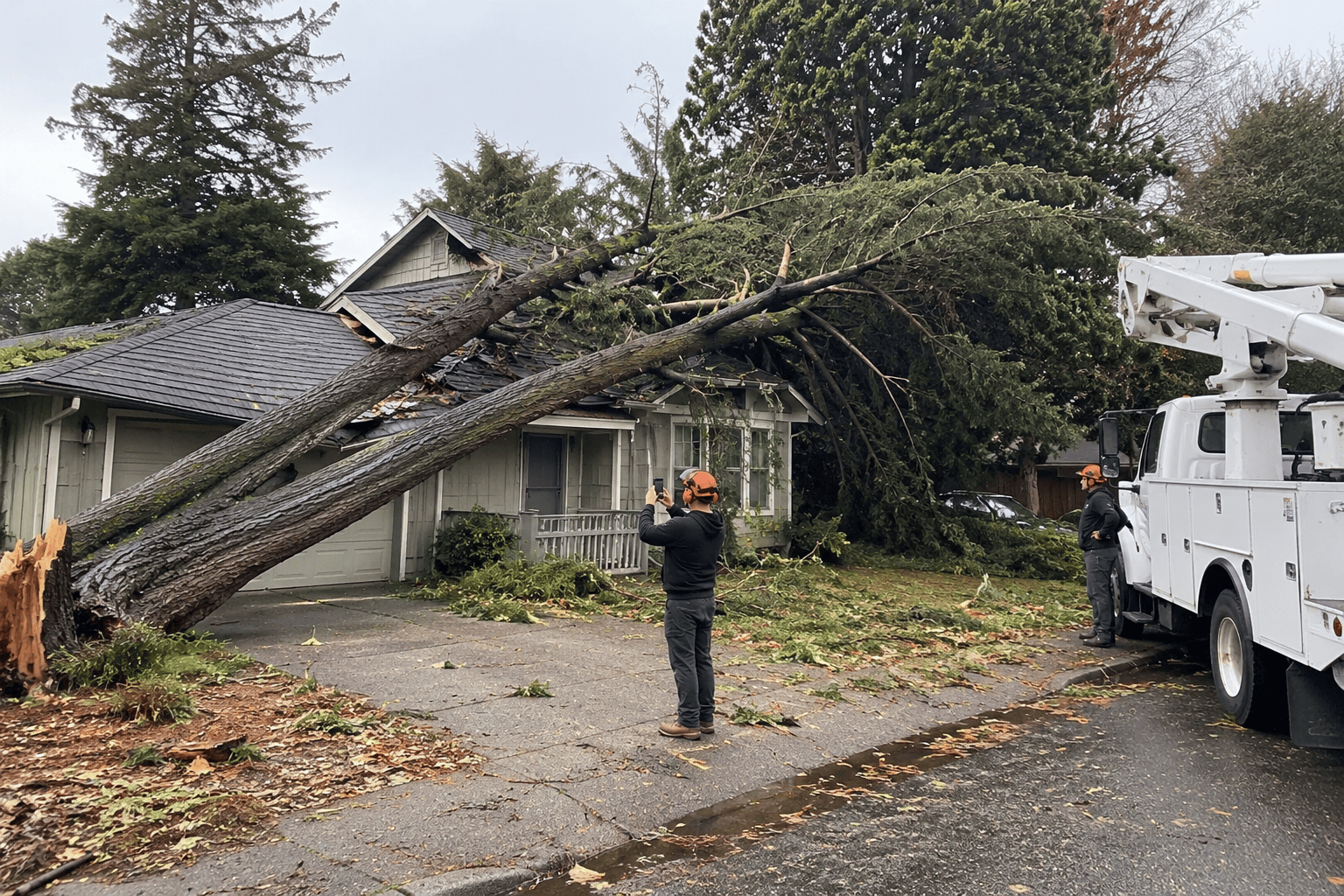
- Keep everyone away from the tree. A fallen trunk that is resting on a fence, a roof, or another tree is under tension and can shift without warning. Do not climb on it and do not let anyone cut it.
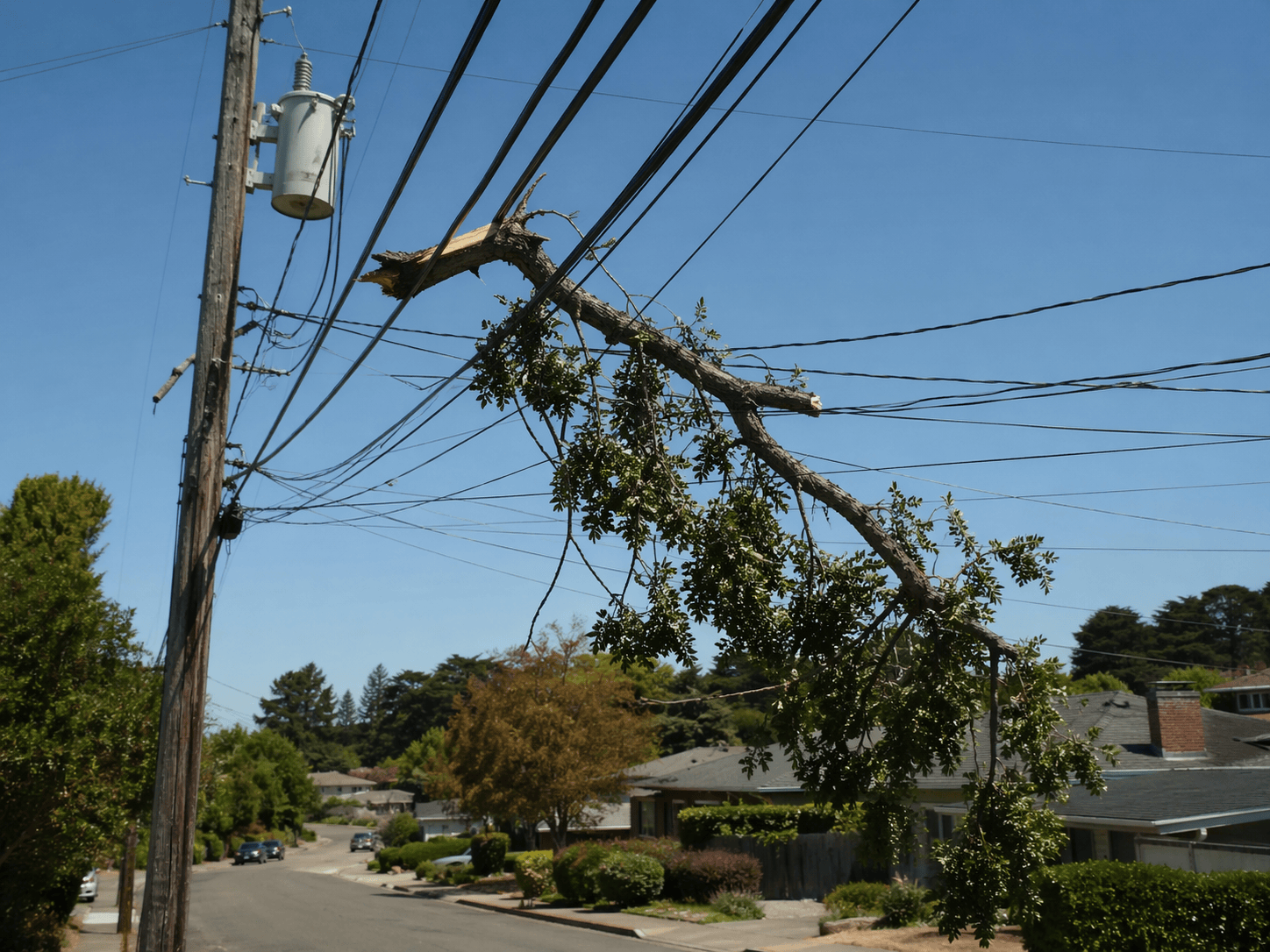
- Look for wires. If the tree brought down or is touching a power line, treat the line as energized, stay at least 30 feet back, and call 911 and PG&E at 1-800-743-5000. Only PG&E or a PG&E-qualified line-clearance contractor works near an energized line.
- Photograph everything before anything is moved. Wide shots showing where the trunk stands in relation to the property line, the root plate, the break point, any visible decay, fungal brackets or hollow wood, and every item that was damaged. Video with narration works too.
- Tell your neighbor, in writing. A short, factual text or email (“your pine came down into our yard this morning, here are photos, we are calling our insurer”) starts a paper trail without starting a fight.
- Call your insurer within 24-48 hours. Ask what they need from you and whether they want the tree left in place until an adjuster sees it.
- Call a licensed arborist for safe removal and a written cause-of-failure assessment. Our 24/7 emergency tree service covers all of San Mateo County: (650) 355-1277.
Who owns the tree in California? Civil Code 833 and 834
California answers the ownership question with two short statutes. Civil Code section 833 says that trees whose trunks stand wholly on one owner’s land belong exclusively to that owner, even if the roots grow into a neighbor’s land. Section 834 covers the trunk-on-the-line case: trees whose trunks stand partly on the land of two or more adjoining owners belong to them in common.
“Trees whose trunks stand wholly upon the land of one owner belong exclusively to him, although their roots grow into the land of another.”
– California Civil Code, section 833
Three practical consequences follow from that rule:
- Trunk on their side: it is their tree. They are responsible for maintaining it, and they carry the liability if negligence is later shown.
- Trunk straddling the line: it is a shared tree. Both of you share maintenance, both of you share liability, and neither of you can remove it without the other’s consent.
- Roots and branches crossing onto your side do not change ownership. They give you a limited right to trim (covered below), not a claim to the tree.
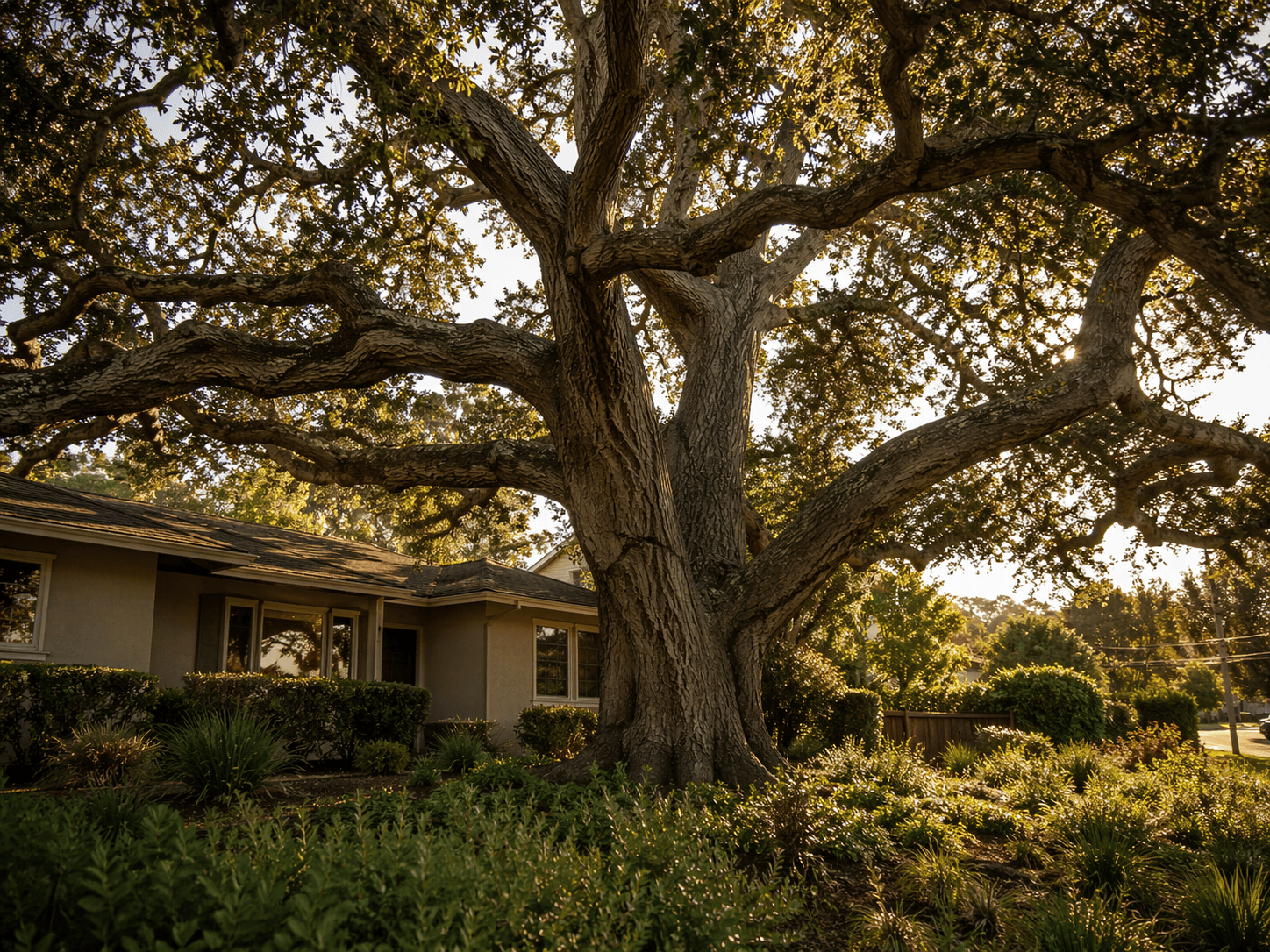
Where the trunk actually stands is not always obvious on the Peninsula. On the narrow lots in Daly City, South San Francisco and San Bruno, fences are often a foot or two off the surveyed line, and a trunk that “looks” like the neighbor’s can straddle it. A survey or the recorded plat settles the question; our arborist notes the trunk position relative to the fence in every report and flags it when a survey is needed.
Who pays when a neighbor’s tree falls: the negligence rule
Owning a tree and being liable for it are two different things. California applies an ordinary negligence standard to fallen trees: the owner is responsible for damage only if they failed to use reasonable care – typically, they knew or reasonably should have known the tree was hazardous and did not act. A healthy tree that fails in an atmospheric river storm is an act of nature, and each owner’s insurance covers each owner’s damage.
Storm or natural failure (most cases)
The tree looked fine, the ground was saturated after a week of rain, a 50 mph gust came through, and it went over. Nobody was negligent. You file with your insurer for your fence, roof, shed, or car; your neighbor deals with whatever landed on their side. This is the outcome in the large majority of San Mateo County cases.
Documented negligence
Liability can shift to the neighbor when there is evidence they knew about the hazard: a written notice you sent, an arborist report they had, a code enforcement complaint, a dead crown that was visible from the street for a year, fungal conks at the base, a lean that grew over several seasons. “Knew” has to be provable. Verbal warnings over the fence are close to worthless; an email with photos, or a certified letter, is not.
Shared tree on the line
If the trunk straddles the line, you both own it and you both carry responsibility. In practice that means each insurer handles its own policyholder’s damage, and any negligence argument is weaker because both of you had the same duty to maintain the tree.
Scenario table: who typically pays, and what to document
Every policy and every set of facts is different, so treat this as the usual pattern rather than a rule. Confirm coverage with your insurer.
| Scenario | Who typically pays | What to document |
|---|---|---|
| Healthy neighbor tree falls in a storm, damages your fence, roof or shed | Your homeowner’s policy (dwelling / other structures), minus your deductible | Photos before cleanup, date and weather, repair estimates |
| Healthy neighbor tree falls in a storm, lands in your yard, no structure damaged | Usually you; many policies pay little or nothing for removal when nothing was hit | Photos, removal invoice; ask your insurer about any debris-removal sublimit |
| Neighbor tree falls on your car | Your auto policy, comprehensive coverage | Photos of the tree on the vehicle, police or incident number if any |
| Neighbor’s tree was visibly dead or diseased and you had warned them in writing | Your insurer pays first, then may pursue the neighbor (subrogation); your deductible may be recovered | Copies of notices, dated photos of the decline, arborist report on cause of failure |
| Trunk straddles the property line | Each owner’s policy for their own damage; removal cost shared by agreement | Survey or plat, photos of trunk position, written cost-sharing agreement |
| Only branches fall into your yard, no damage | You, for cleanup on your side | Photos and dates, especially if it keeps happening |
| Tree brings down a PG&E line | PG&E restores the line; property damage follows the rules above | PG&E incident number, photos taken from a safe distance |
What your insurance actually covers
The California Department of Insurance, in its consumer alerts issued after the state’s winter storms, describes the coverage picture in plain terms: damage from fallen trees is generally covered under standard homeowner policies, and a vehicle crushed by a tree is generally covered under the comprehensive portion of an auto policy. The Department’s advice on documentation is also worth repeating.
“Take pictures and keep records of all clean up and repair costs. Don’t make permanent repairs until the insurance adjuster sees the damage.”
– California Department of Insurance, consumer alert on insurance coverage following winter storms
Here is how a typical neighbor-tree claim moves:
- Your policy responds first. Dwelling coverage pays for the house, “other structures” coverage pays for fences, sheds and detached garages, subject to your deductible.
- Tree removal is usually covered only when the tree hit a covered structure or blocks a driveway or a ramp for a disabled resident. Most policies cap tree and debris removal at a per-tree or per-event sublimit; check your declarations page rather than assuming the whole removal bill is covered.
- Subrogation. If your file shows the neighbor was negligent, your insurer can pay you and then pursue the neighbor or their carrier to recover what it paid. You do not litigate this yourself, and if it succeeds you may get your deductible back.
- The arborist report is the pivot. Adjusters decide whether subrogation is worth pursuing based on evidence of the tree’s condition before it failed. A licensed arborist’s cause-of-failure report that documents decay, root rot or a prior structural defect is exactly that evidence.
If you are putting a claim together, our guide to the photos and documents a fallen-tree claim needs has the full checklist.
Can you cut a neighbor’s overhanging branches in California?
Yes, within limits. Long-standing California practice lets a property owner trim branches and roots that cross onto their side, back to the property line, without the neighbor’s permission – as long as the trimming does not damage the health or stability of the tree. That last clause is where people get into trouble.
- Branches over your side: you may cut them back to the line. You may not reach over the line, and you may not top or strip the tree so badly that it declines.
- Roots on your side: you may cut them, but severing large structural roots can destabilize the tree, and if it later falls the cut roots become evidence against you.
- Protected species: most San Mateo County cities regulate heritage or protected trees by trunk size or species, and heavy pruning of a protected tree – even from your side of the fence – can require a permit. Our post on protected trees in San Mateo County and how to avoid fines explains how the rules differ by city.
- Killing the tree: if your cutting kills or ruins the tree, you can be liable for its value, and California law allows enhanced damages for wrongful injury to trees. Do not find out how much a mature coast live oak is worth this way.
The safe route is a licensed arborist doing the work from your side with a written scope and photos. That protects you from a “you killed my tree” claim later, and it keeps the cuts at the branch collar where the tree can seal them.
San Mateo County specifics: why this happens here
National articles on this topic treat a fallen tree as a rare event. On the Peninsula it is a seasonal one. From November through March, atmospheric rivers drop days of rain that saturate hillside and bay-fill soils, and the wind that follows pushes over trees whose root plates have lost their grip. What our crew sees on neighbor-tree calls, again and again:
- Blue gum eucalyptus – shallow-rooted, tall, and heavy-crowned. A single eucalyptus in a Pacifica or Half Moon Bay backyard can span two or three lots when it goes over. Its branches also shed in wind, which is why so many “branch fell in my yard” calls involve this species.
- Monterey pine and Monterey cypress – planted by the thousands mid-century, now at the end of their life, often weakened by pitch canker or bark beetles. Dead tops and brown flagging branches are exactly the kind of visible warning that turns a storm failure into a negligence question.
- Dense lots in South San Francisco, Daly City, San Bruno and Millbrae – lots of 3,000-5,000 square feet where any mature tree is within falling distance of at least two neighbors. There is no “empty side” for a tree to fall toward.
- Coast live oaks with root damage from a neighbor’s driveway or drainage work, or with Sudden Oak Death, in the wooded parts of Hillsborough, Menlo Park and the Woodside-adjacent hills.
Two other local points matter. First, PG&E, not your neighbor, is responsible for keeping vegetation clear of its lines; if the tree fell into a line, our guide to trees on power lines and PG&E rules covers who does what. Second, if the fallen tree was a protected species, the city may still want a removal permit or at least an after-the-fact notice, even for a tree that is already on the ground. Most cities waive the process for an emergency, but ask – or let us handle the notice as part of the job.

Evidence that decides a neighbor-tree claim
Whether you are the one whose yard got hit or the one whose tree fell, the same evidence decides the outcome. Collect and keep:
- Any photos of the tree from before it fell – old listing photos, holiday photos, Google Street View captures with dates – showing a dead top, a lean, cavities or fungal brackets.
- Post-fall photos before cleanup, from several angles, including the trunk position relative to the fence.
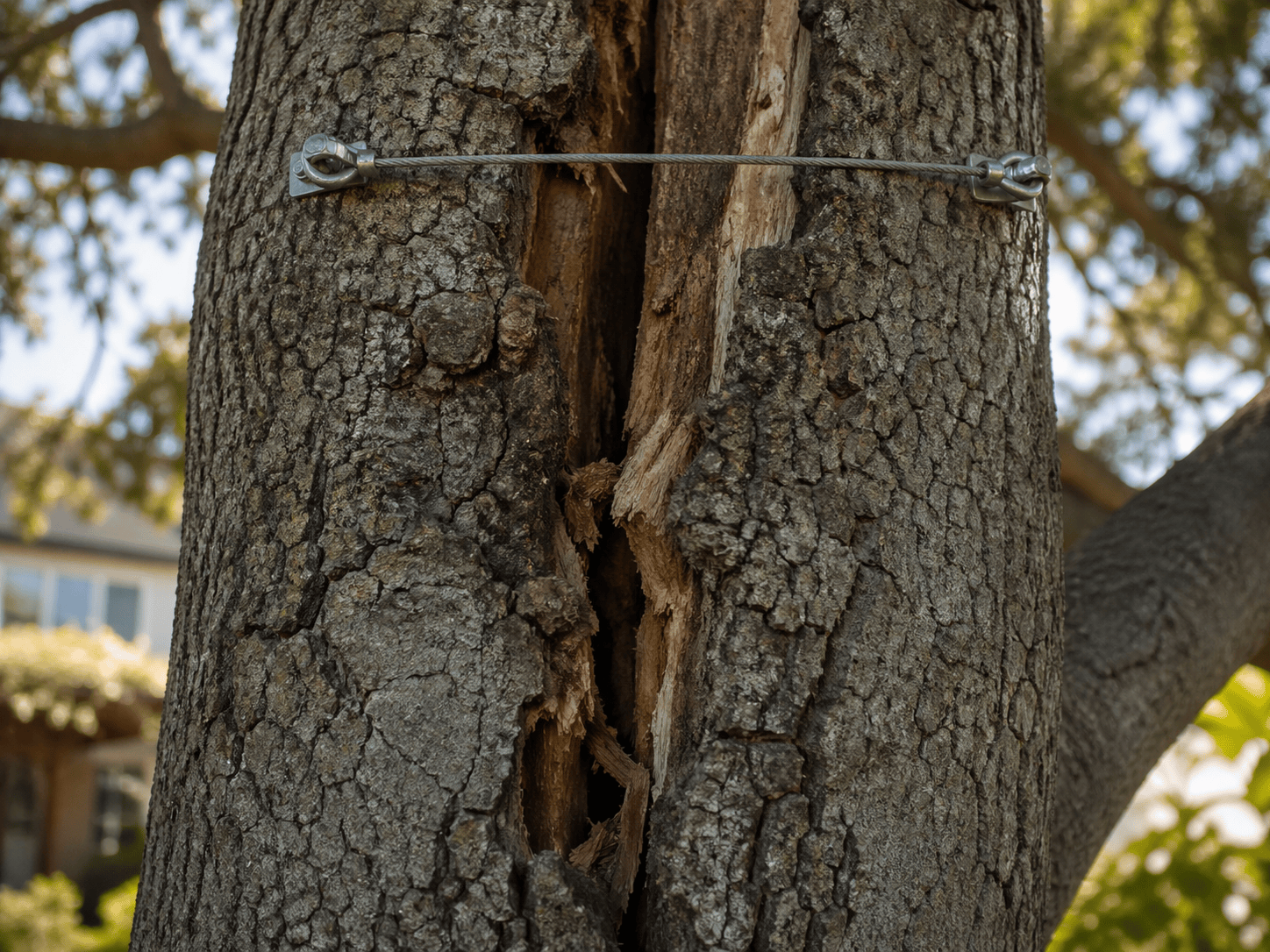
- Close-ups of the root plate and the break. Fresh, bright, snapped wood suggests a sound tree that failed under load. Dark, spongy, hollow wood and mushrooms at the base suggest decay that predated the storm.
- Copies of any written notice you sent, or received, about the tree.
- Weather data for the date – the National Weather Service records for San Francisco International or Half Moon Bay airport are easy to pull.
- A written arborist report on cause of failure.
- Invoices from a licensed tree service for removal and cleanup.

When to involve a lawyer, and when not to
Most neighbor-tree situations never need one. Your insurer handles your claim, subrogation happens or it does not, and the neighbors stay on speaking terms. Consider a California property attorney when the damage clearly exceeds your coverage, when the neighbor denies responsibility in the face of strong negligence evidence, or when a neighbor refuses to deal with a standing tree that is clearly hazardous to your home. For smaller amounts, California small claims court handles claims up to a limit set by state law (currently $12,500 for individuals) without a lawyer, and a well-organized file – report, photos, notices – is what wins there.
The reverse case deserves a sentence too: if it was your tree that fell onto the neighbor’s house, the same rules apply. Their insurer pays their damage unless you were negligent. Keeping an annual inspection record for your own mature trees is the least expensive liability protection available.
What a removal and cleanup typically costs
Costs depend on the size of the tree, what it landed on, and whether rigging or an aerial lift is needed to get it off a structure safely. As a rule of thumb, a small tree removal typically runs about $300-$600, and a large or hazardous removal $1,000-$3,000 or more. Every Precision Tree Care estimate includes removal, dumping and hauling, so the number you see is the number you pay – no callbacks for extra charges. Because every fallen-tree job is different, the only honest number is a free on-site estimate.
How Precision Tree Care handles a neighbor’s fallen tree
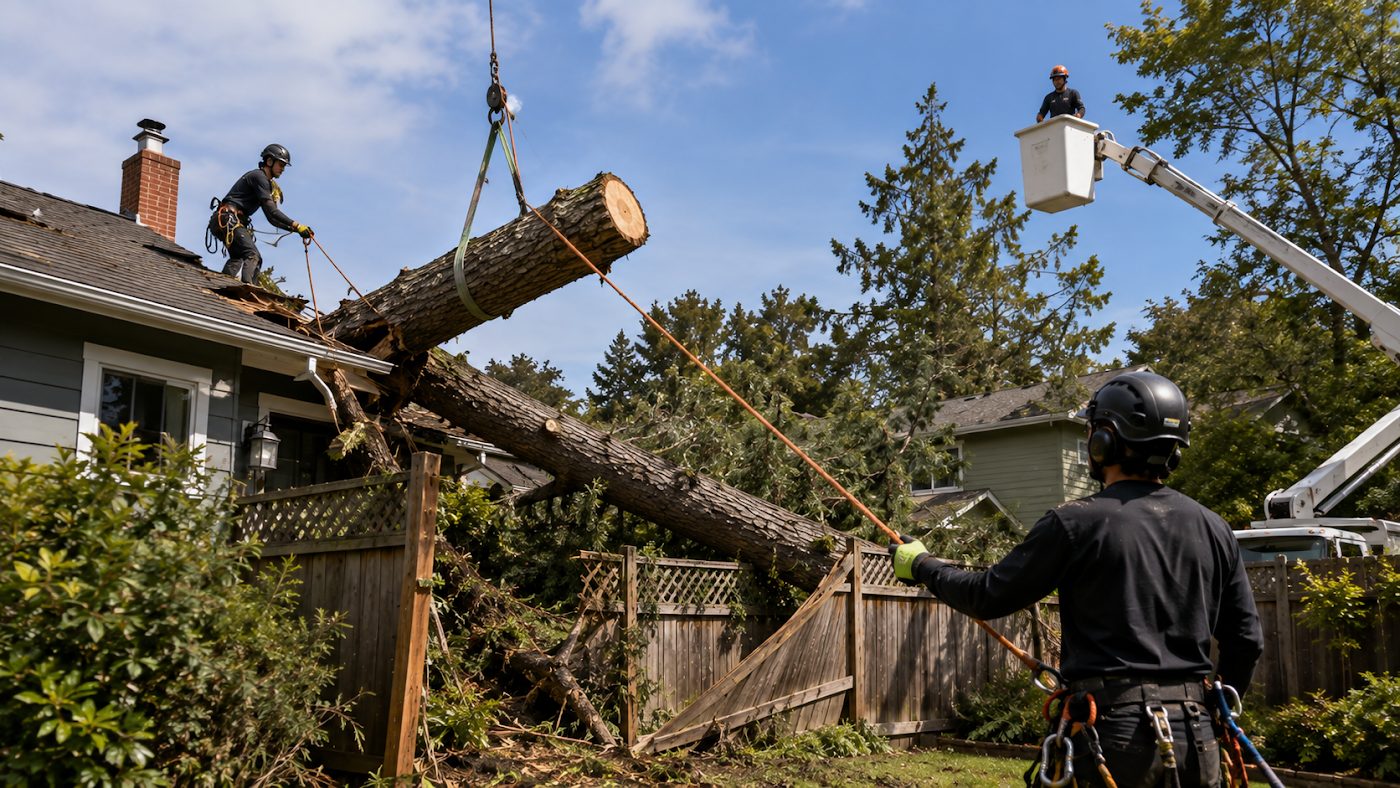
On a neighbor-tree call the job has two halves: get the tree off your property safely, and capture the evidence before it is gone. Our ISA Certified Arborist documents the trunk position, the root plate and the failure point before the crew starts cutting, because once the tree is chipped there is nothing left to examine. For a tree resting on a roof or fence we rig sections down piece by piece, or bring in an aerial lift where there is access, rather than dropping weight onto whatever is under it. Wood is chipped and hauled the same day, and we leave the yard clean – no debris, no mess, no worries. If you want the chips for mulch, just ask.
The written cause-of-failure report is what turns a stack of phone photos into something an adjuster, an attorney or a small claims judge can act on: species, dimensions, trunk location relative to the line, condition of roots and wood, visible pre-existing defects, and the arborist’s opinion on why the tree failed. Where the neighbor’s standing trees are also a concern, a TRAQ risk assessment on those trees gives you the written notice that matters if one of them comes down next winter.
Precision Tree Care has served San Mateo County since 2005, backed by 40+ years of family expertise. Our work is led by an ISA Certified Arborist (#WE-12520A), we hold California Contractors License #907593, and we carry full liability and workers’ compensation insurance – so an insurer, an attorney or a permit office can rely on our documentation. For the full emergency sequence, see our guide on what to do when a tree falls on your house.
Neighbor’s tree in your yard? Get it removed and documented the same day.
Safe removal plus a written arborist cause-of-failure report for your insurer, anywhere in San Mateo County. Free estimates, no hidden fees – removal, dumping and hauling are included.
Request a Free Estimate
or call (650) 355-1277 – 24/7 for emergencies
Frequently asked questions
My neighbor’s tree fell on my property in California. Who is responsible?
Usually you are, through your own homeowner’s insurance. California treats a tree that falls in a storm as an act of nature, so each owner’s policy covers each owner’s damage. The neighbor becomes responsible only if you can show they knew, or should have known, the tree was dead, diseased or unstable and failed to act. Written notices and an arborist report are the evidence that shifts liability.
Will my neighbor’s insurance pay for damage their tree caused?
Not unless negligence is shown. Your insurer pays your claim first. If your file contains evidence the neighbor ignored a known hazard – prior written warnings, an arborist report flagging the tree, a visibly dead crown – your insurer may pursue the neighbor’s carrier through subrogation and recover what it paid, which can include your deductible.
Who pays to remove a neighbor’s tree that fell in my yard but did not hit anything?
Typically you do. Most homeowner policies pay for tree removal only when the tree damaged a covered structure or blocks a driveway, and even then within a sublimit. If nothing was hit, the removal is usually out of pocket unless the neighbor was negligent. Ask your neighbor to share the cost; many will, and a written agreement avoids a later dispute.
What if my neighbor’s tree fell on my car during a storm in California?
Your own auto policy covers it under comprehensive coverage, not the neighbor’s insurance. The California Department of Insurance notes that vehicles damaged by fallen trees are generally covered under the comprehensive portion of an auto policy. If you carry liability only, you would need to prove the neighbor’s negligence to recover from them.
How much of my neighbor’s tree can I legally cut in California?
You may trim branches and roots back to your property line without permission, as long as you do not damage the health or stability of the tree. You may not cut past the line, and if your cutting kills the tree you can be liable for its value. Protected species in many San Mateo County cities may also require a permit for heavy pruning.
The trunk is on the property line. Who owns the tree?
Under California Civil Code section 834, a tree whose trunk stands partly on two adjoining lots belongs to both owners in common. Both share maintenance and liability, and neither may remove it without the other’s consent. Because fences on Peninsula lots often sit off the surveyed line, a survey or recorded plat may be needed to confirm where the trunk actually stands.
Can I force my neighbor to remove a dangerous tree in San Mateo County?
Not directly, but you can build the record that makes them responsible. Send a written notice with photos, commission a TRAQ risk assessment from a licensed arborist and share it, and report a visibly hazardous tree to your city’s code enforcement office. If the tree later fails, that documentation is what shifts the cost to the neighbor.
Do I need an arborist report for a neighbor’s fallen tree?
If there is any chance the tree was already in poor condition, yes, and it needs to be done before the tree is cut up. A licensed arborist’s cause-of-failure report documents the trunk location, root plate, decay and defects, and gives your insurer the evidence it needs to decide on subrogation. Without it, a storm failure and a neglected tree look the same in photos.