
Over-Pruned or Topped Trees: How to Fix Them and Stop Regrowth Problems
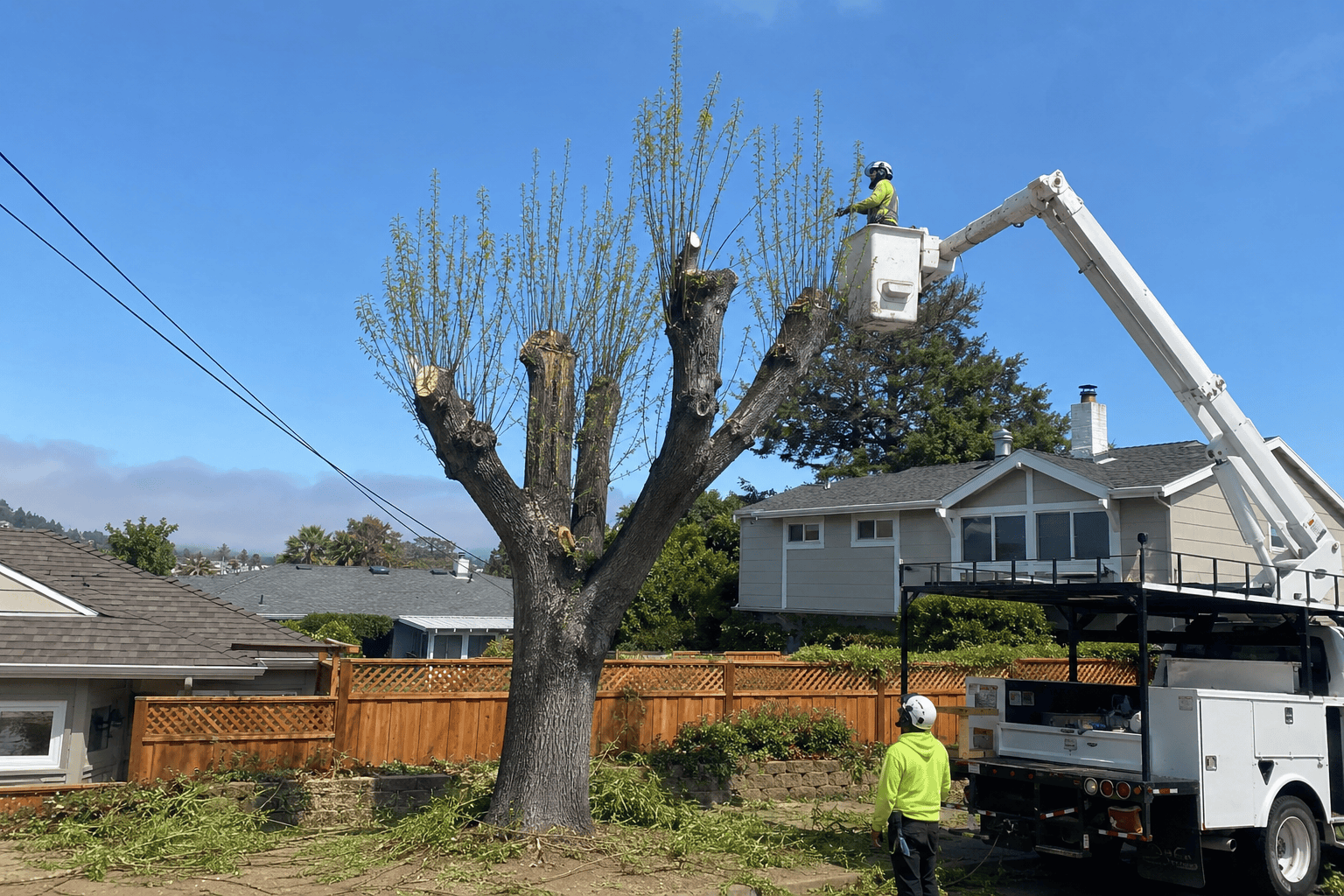
Tree topping – the practice of cutting back large branches or the central leader to stubs – is one of the most damaging things that can be done to a tree. It looks like a quick size-reduction fix but triggers uncontrolled regrowth, structural weakness, and long-term decline that often ends with removal 10 to 15 years later. Over-pruning (removing too much live canopy in a single season) has similar consequences on a slower timeline.
This guide explains what topping does to trees, how to recognize the damage, how crown restoration works, and what alternatives to use instead. Damage from topping cannot be fully reversed, but careful corrective work by a certified arborist can salvage many topped trees and extend their useful life by decades. Precision Tree Care’s ISA Certified Arborist (#WE-12520A) handles crown restoration across San Mateo County; call (650) 355-1277.
What is tree topping?
Topping is the indiscriminate cutting of large branches back to stubs or lateral branches too small to assume the role of terminal leader. It is distinct from legitimate pruning techniques:
- Topping: cutting large limbs to stubs; no regard for tree structure or biology
- Crown reduction: careful reduction of size by cutting back to suitable lateral branches; maintains natural shape
- Crown thinning: selective removal of smaller branches throughout the canopy to reduce density
- Structural pruning: selective cuts to improve long-term branch architecture
Topping is prohibited or discouraged by the International Society of Arboriculture, ANSI A300 pruning standards, and most municipal tree ordinances including many in San Mateo County. Properly trained arborists practicing crown reduction and thinning never top trees – they use alternative methods that achieve size control without the damage.
Why topping damages trees
Biological impact
- Massive leaf loss eliminates photosynthesis capacity, starving the tree
- Sunscald – previously shaded bark burns in direct sun, causing cambium damage
- Large wounds at stub cuts rarely seal properly and provide entry for decay fungi and insects
- Stress response triggers emergency water-sprout regrowth that is physiologically different from normal branches
Structural impact
- Water sprouts grow fast (2 to 10 feet per year) but have weak attachment
- Multiple water sprouts from each topping cut create dense, crowded regrowth
- New growth breaks easily in wind, often worse than the original limbs would have
- Decay progresses behind the stub cuts, eventually hollowing limbs and trunk
Timeline
- Year 1 to 2: fast, dense regrowth; tree looks “fixed”
- Year 3 to 7: regrowth becomes heavy; decay begins behind stubs
- Year 7 to 15: structural failures start – water sprouts break, stubs rot, the tree visibly declines
- Year 15+: removal often becomes necessary
The practice that “saved” money on size control in year 1 often costs more in repeated maintenance, eventual removal, and replacement than correct pruning would have cost over the same period.
Does topping a tree kill it?
Not always immediately, but it shortens the tree’s useful life significantly. Some species tolerate topping better than others:
- Most affected: Monterey pine, eucalyptus, most conifers – often decline rapidly
- Moderately affected: oaks, maples, elms – survive but with long-term decay
- Resilient but still damaged: some fruit trees, willows – can recover more of their form but still lose years
A topped tree will almost always have a shorter life than a properly maintained tree of the same species, and will be more expensive to maintain throughout that shortened life.
How to fix an over-pruned or topped tree
Crown restoration is a multi-year process, not a single-visit fix.
Year 1: Initial assessment and selection
- Certified arborist evaluates what can be salvaged
- Among the water sprouts that emerged, one per stub is selected to become the new leader for that branch
- The selected water sprouts are typically those that are well-positioned, attached to the stub with the best angle, and vigorous
- No heavy pruning yet – the tree needs every leaf it has to recover
Year 2 to 3: Reduction of competing growth
- Water sprouts not selected as new leaders are shortened, not removed entirely
- This reduces competition while keeping some photosynthesis from those branches
- Selected leaders are allowed to grow freely to become dominant
Year 4 to 6: Ongoing structural correction
- Competing water sprouts gradually removed
- Selected leaders pruned lightly to encourage proper form
- Any decay detected behind old stub cuts is addressed with clean cuts back to sound wood if feasible
Year 6+: Transition to normal maintenance
- The tree has re-established a single leader per branch
- Regular crown reduction and thinning replace corrective work
- Ongoing monitoring for decay behind old topping cuts
Crown restoration costs more per visit than topping did, but spread over years delivers a healthier tree than the topped-and-retopped alternative. Some trees topped too severely cannot be restored and should be removed and replaced – an honest arborist will say so.
Alternatives to topping
- Crown reduction: careful shortening of branches to appropriate laterals; maintains natural form and canopy density
- Crown thinning: selective removal of smaller interior branches; reduces density and wind load without changing overall shape
- Structural pruning for young trees: corrects problems before they become structural
- Directional pruning: guides growth away from structures or power lines over time
- Tree replacement: if the tree is in the wrong location for its mature size, the right answer may be removal and planting a more appropriate species nearby
Any reputable company offering fine pruning services in San Mateo County will decline to top a tree and offer these alternatives instead.
Costs of topping correction
| Service | Typical cost | Frequency |
|---|---|---|
| Arborist assessment of topped tree | $150 – $400 | One-time |
| Initial corrective pruning (year 1) | $400 – $1,200 | Year 1 |
| Follow-up restoration (annual) | $300 – $1,000 | Years 2 to 6 |
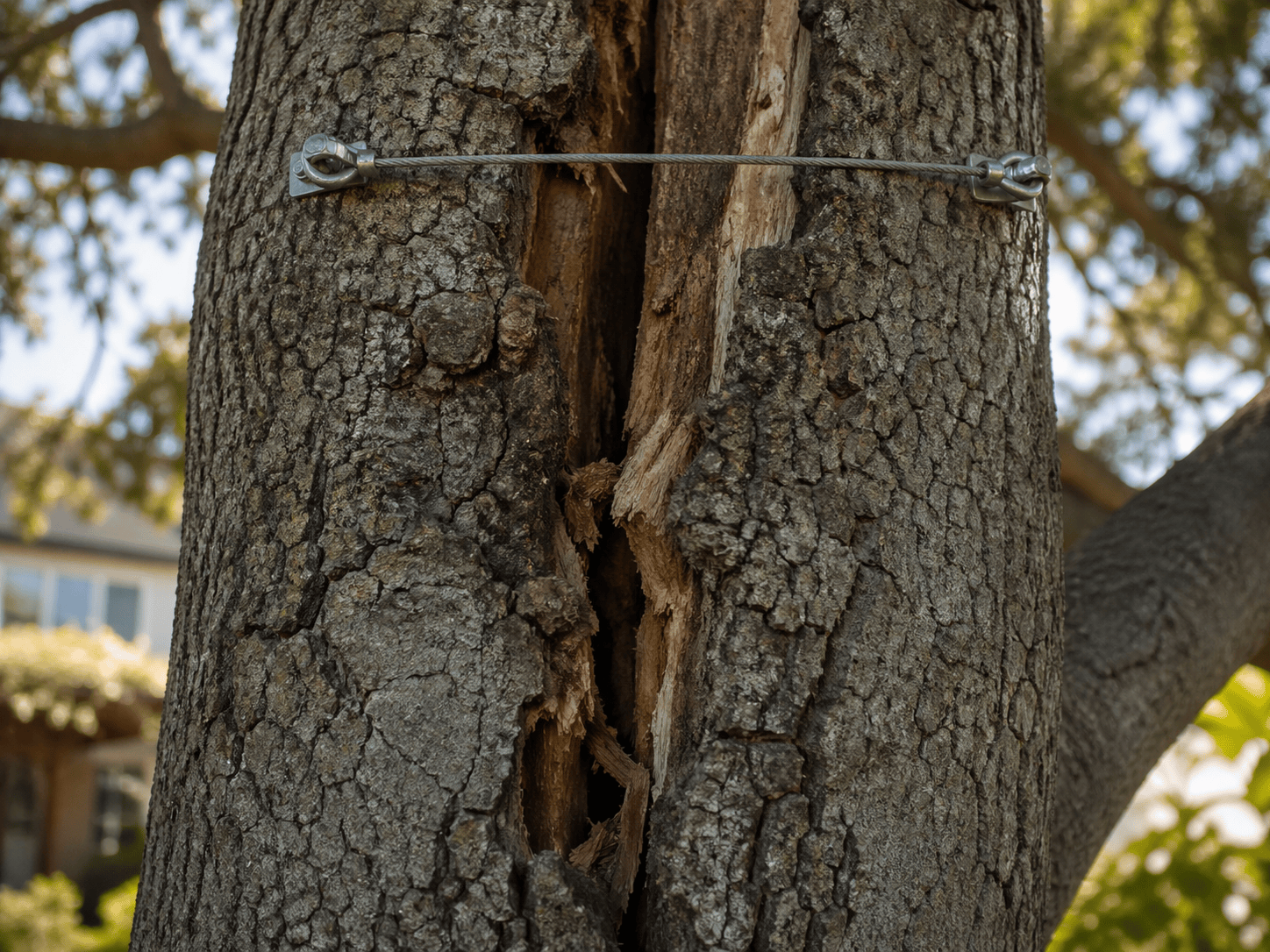
| Cabling of weak new unions | $400 – $1,500 | As needed |
| Removal if beyond salvage | $800 – $3,500 | If restoration is not viable |
Local rules and topping
Several San Mateo County cities explicitly prohibit topping of protected trees, and many include anti-topping language for any pruning work done by permit. Unauthorized topping of a protected tree can trigger the same fines as unauthorized removal – $1,000 to $10,000 per tree depending on the city. If you are considering topping to “reduce size,” check your city’s tree ordinance first and get a second opinion from a certified arborist.
Prevention: avoid topping in the first place
- Plant the right tree in the right place – if mature size is incompatible with the space, choose a smaller species
- Start structural pruning on young trees – correct problems before they require major work
- Schedule regular maintenance pruning every 2 to 5 years, never waiting until “something must be done now”
- Hire certified arborists only – check ISA certification (ours is #WE-12520A) before authorizing work
- Avoid “we’ll just cut it back hard” bids – this is almost always code for topping
Frequently asked questions
1. What is the difference between topping and crown reduction?
Topping cuts large branches to stubs with no regard for biology or structure. Crown reduction cuts back to appropriate lateral branches that can assume the role of new terminal leaders – maintaining the tree’s natural form and growth response. Topping triggers emergency water sprouts; crown reduction produces normal secondary growth. Topping causes long-term decline; crown reduction done well extends tree life. The two techniques are categorically different despite sometimes looking superficially similar after year 1.
2. Can a topped tree be saved?
Often, yes, but never fully restored to what it would have been. Crown restoration over 3 to 6 years can produce a structurally sound, attractive tree with significantly extended life compared to doing nothing. Success depends on species (oaks and maples respond better than pines), severity of topping (stubs under 3 inches can heal; 10+ inch stubs usually rot), and whether restoration starts within 1 to 2 years after topping. Some severely topped trees are beyond salvage and should be replaced.
3. How long does crown restoration take?
Typically 3 to 6 years of active corrective pruning, followed by ongoing normal maintenance. Year 1 selects replacement leaders. Years 2 to 3 reduce competing regrowth. Years 4 to 6 transition to normal structure. Throughout, the arborist monitors for decay at old stub cuts and may perform minor corrective cuts in between major visits. By year 6, the tree usually looks substantially normal again, though experienced eyes will often still detect the original topping.
4. Why does topping cause so much regrowth?
It is a survival response. When a tree loses most of its leaves at once, it activates latent buds along the remaining branches and trunk to grow emergency replacement foliage quickly. These emergency branches (water sprouts) grow from surface tissue rather than from proper branch unions, which is why they attach weakly and break easily. The regrowth is the tree’s panic response to near-starvation, not normal growth.
5. Is topping ever appropriate?
Rarely, and only in specific situations: some pollarding traditions (European willow and plane tree management), a few fruit tree training systems, and emergency situations where a limb must be drastically shortened because it threatens a structure but removal is not yet an option. For normal ornamental or native trees in residential settings, no, topping is never the right answer. A certified arborist will offer crown reduction or thinning instead.
6. Why do some tree companies still top trees?
Economics and customer demand. Topping is fast and requires less skill than proper crown reduction – it is cheaper for untrained crews to bid low on. Some homeowners request “cut it way back” without knowing the implications, and unlicensed or under-trained crews comply. Professional companies with certified arborists decline these requests and explain alternatives. If a crew is willing to top a tree without discussion, that is a warning sign about their training and ethics.
7. Will my city fine me for topping a tree?
Many San Mateo County cities include anti-topping language in their tree ordinances, especially for protected species. Unauthorized topping of a protected oak or heritage tree can trigger fines comparable to unauthorized removal – $1,000 to $10,000 per tree. Topping non-protected trees is typically not fined but may violate permit conditions if the work was done under a permit. Check your city’s ordinance before authorizing any major pruning.
8. My tree was topped before I bought the house – what do I do?
Schedule an assessment with a certified arborist. The first question is whether the tree is worth restoring given species, current condition, and location. If yes, begin corrective pruning – the sooner after the original topping, the better the outcome. If the tree is severely damaged or in the wrong location, plan for removal and replacement with a more appropriate species. Either way, do not top it again – repeated topping accelerates decline dramatically. Free assessments available at (650) 355-1277.