
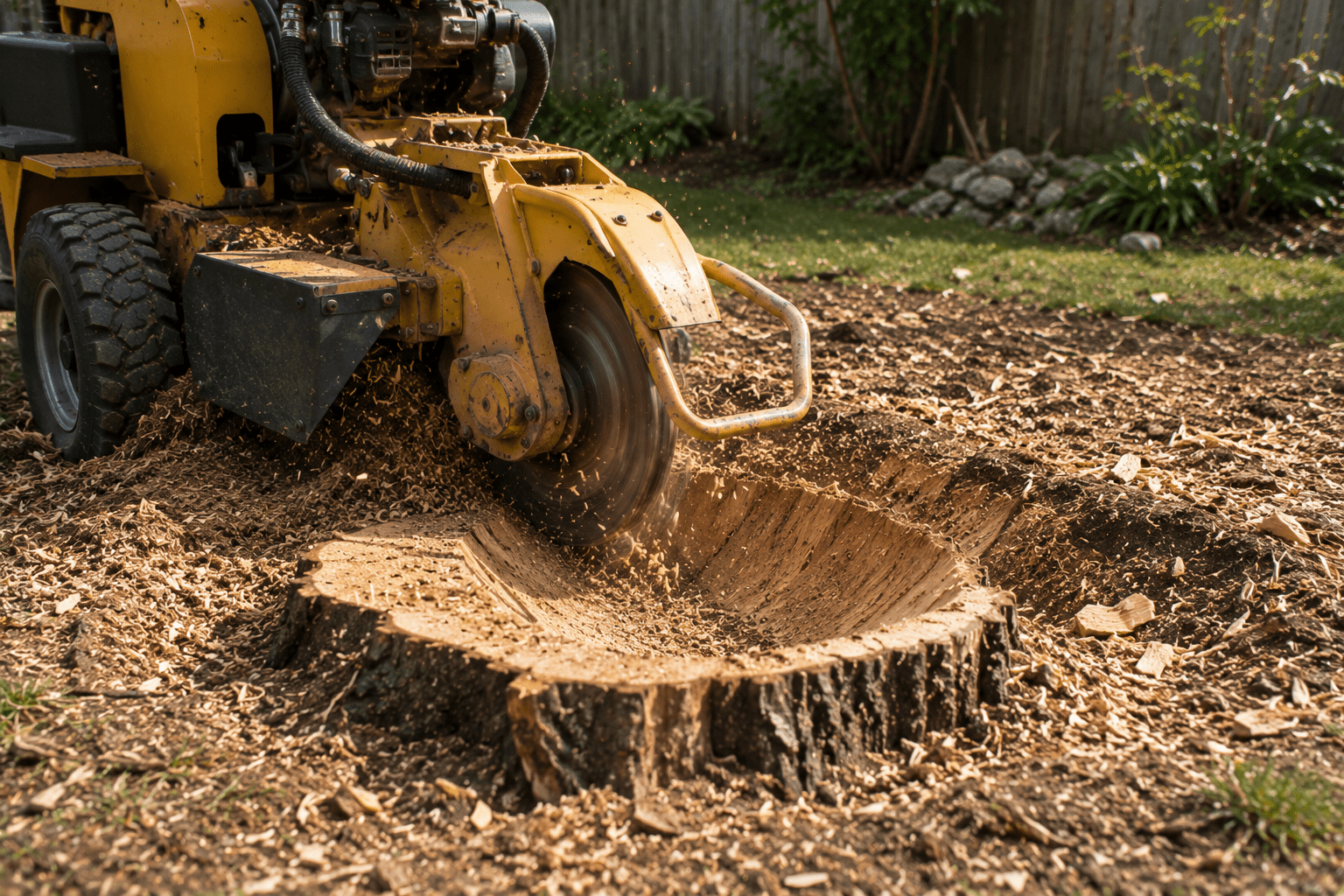
Stump Grinding Depth: How Deep Does It Go and What to Expect
After a tree comes down, the stump is often the last thing people think about – until they try to mow around it, plant grass over it, or build something on the spot. Stump grinding is the most common way to eliminate a visible stump, but homeowners are often unclear on how deep it actually goes, what is left behind, and whether grinding is enough for their plans. The right depth depends entirely on what you want to do with the area afterward.
This guide explains standard and deep stump grinding depths, what factors affect how far the grinder can go, how long the job takes, and what to expect once the grinder leaves. For San Mateo County homeowners, Precision Tree Care offers professional stump grinding and removal at depths tailored to your plans – from basic lawn leveling to full construction preparation.
How deep does standard stump grinding go?
Standard stump grinding removes the stump to below ground level, typically 4 to 6 inches below grade. This is the default for most residential jobs and is enough for:
- Mowing the area without hitting anything
- Filling with soil and planting grass or ground cover
- Eliminating the tripping hazard
- Preventing regrowth from the stump itself (though some species may send up shoots from remaining roots)
If nothing more aggressive is specified, this is what most tree services will deliver. The grinder leaves a pile of wood chips mixed with soil in and around the hole.
Deep stump grinding: 8 to 12+ inches
When plans for the area go beyond lawn, deeper grinding is needed:
- Replanting grass or small plants: 6 to 8 inches is usually enough
- Replanting trees or large shrubs in the same spot: 10 to 12+ inches, and the grindings should be removed and replaced with fresh soil
- Installing hardscape (patio, walkway): 10 to 12 inches, with all wood material removed
- Foundation, fence post, or structural element: 12+ inches and full root removal, which may require excavation rather than grinding
Deep grinding takes longer and costs more, but skipping it when you need it means settling, soft spots, or plants that cannot establish because they are growing in decomposing wood.
What limits how deep the grinder can go?
- Tree species. Hardwoods (oak, maple) are slower to grind than softwoods (pine, eucalyptus). Same depth takes longer and wears cutters faster.
- Root flare size. Large buttress roots extend horizontally several feet from the trunk. Grinding the main stump does not remove them; separate grinding of the flares adds time and cost.
- Soil conditions. Rocky soil wears cutter teeth quickly; compacted clay slows the grinder.
- Access. Equipment size matters. Narrow gate access limits crews to smaller grinders with shallower reach.
- Utility concerns. Buried gas, water, electrical, or irrigation lines limit depth. Always call 811 before stump grinding (free in California), and mark sprinkler lines yourself.
How long does it take?
Rough time estimates for standard depth (4 to 6 inches):
| Stump diameter | Time for standard grinding | Time for deep grinding (10+ inches) |
|---|---|---|
| Under 12 inches | 15 to 30 minutes | 30 to 60 minutes |
| 12 to 24 inches | 30 to 90 minutes | 60 to 180 minutes |
| 24 to 36 inches | 1 to 3 hours | 2 to 5 hours |
| 36+ inches (major root flare) | 2 to 4 hours | 4 to 8+ hours |
Most residential jobs are completed in a single crew visit.
Typical costs in San Mateo County
| Service | Typical cost | Notes |
|---|---|---|
| Standard grinding (4 to 6 inches) | $100 – $400 per stump | Based on diameter |
| Deep grinding (8 to 12+ inches) | $300 – $800 per stump | For replanting or hardscape prep |
| Major root flare grinding | +$100 to $300 | Grinds buttress roots separately |
| Grinding cleanup and removal of chips | +$50 to $200 | Optional – chips can be used as mulch |
| Bundled with tree removal | Often discounted 15 to 25 percent | Same-crew efficiency |
Bundling grinding with tree removal is almost always cheaper than separate visits.
What is left behind
After grinding, the hole is filled with:
- Wood chips (the ground-up stump and roots)
- Soil from the original hole
- Larger root fragments that the grinder did not fully pulverize
Important to know: wood chips do not equal topsoil. They decompose over 1 to 3 years, and while they decompose they:
- Settle, leaving a depression at the grinding site
- Tie up nitrogen from surrounding soil as bacteria break them down
- Are a poor medium for most plants to establish roots in
If you plan to replant anything more ambitious than grass, remove the grindings (many tree services will do this for a fee) and replace with fresh soil before planting.
Preparing for stump grinding
- Mark buried utilities. Free through 811 in California (call 3 days ahead) for gas, water, and electric. Mark sprinkler lines yourself with flags.
- Clear the area. Remove rocks, lawn ornaments, and anything loose within 10 feet – grinders throw chips and small debris.
- Plan for noise. Stump grinders are loud. Warn neighbors, especially in dense neighborhoods in Daly City or Pacifica.
- Decide about chips. Do you want them left as mulch, hauled away, or given to a neighbor? Decide before the crew arrives.
When grinding is not enough
Stump grinding leaves roots in the ground. For most situations this is fine – roots decay over years without issue. Full root removal (excavation, not grinding) is needed when:
- You are building a structure on the spot (foundation, patio, shed)
- Roots are actively damaging pipes or foundation and need to be traced back
- You want to replant a tree immediately in the exact same location
- You have persistent regrowth problems from root suckers (some species like elm, poplar, and black locust send up shoots from roots for years)
Full extraction costs 2 to 5 times more than grinding and leaves a much larger hole.
Frequently asked questions
1. How deep does stump grinding go?
Standard stump grinding goes 4 to 6 inches below ground level. Deep grinding, available on request, reaches 8 to 12 inches or more. The right depth depends on what you plan to do with the area: 4 to 6 inches is enough for lawn, 6 to 8 inches for planting grass or small plants, 10 to 12+ inches for tree replanting or hardscape installation. Full root extraction (excavation, not grinding) is needed only for structural construction on the exact spot.
2. How far down do you grind a stump for planting a new tree?
Minimum 10 to 12 inches below grade, and the grindings should be removed and replaced with fresh soil before planting. Even at that depth, new tree roots will encounter decomposing wood for a year or two, which slows establishment. For best results, plant the new tree 4 to 6 feet away from the old stump’s location, not directly in it. If replanting in the exact same spot is essential, expect slower growth in the first 2 years and consider full root extraction instead of grinding.
3. How long does stump grinding take?
Most residential jobs finish in 15 minutes to 3 hours, depending on stump diameter and requested depth. Small stumps under 12 inches diameter: 15 to 30 minutes at standard depth. Medium stumps (12 to 24 inches): 30 to 90 minutes. Large stumps (24 to 36 inches): 1 to 3 hours. Very large stumps with extensive root flare, or deep grinding jobs, can take 4 to 8 hours. Most single-stump residential jobs are completed in one crew visit.
4. Will roots keep growing after stump grinding?
The stump itself is dead and will not regrow. Major roots remain in the ground but almost always decay naturally over 1 to 5 years. A few species – black locust, poplar, some elms, and certain fruit trees – can send up shoots (suckers) from remaining roots for several years. These can be cut or treated as they appear. If regrowth is persistent, full root extraction or a systemic herbicide treatment on sucker shoots eliminates it.
5. Can I plant grass over a ground stump?
Yes, usually. The steps: (1) have the stump ground to at least 4 to 6 inches below grade; (2) remove the wood chips from the hole if possible – they make poor seed medium and will decompose unevenly; (3) fill with fresh topsoil; (4) seed or sod as normal. If you seed over wood chips, expect patchy germination and plan to reseed after a year as the chips decompose and the surface settles. For best results, give the area a week to settle after grinding before planting.
6. Do I need a permit for stump grinding?
In San Mateo County, generally no for stump grinding itself – permits regulate tree removal, not post-removal cleanup. Two exceptions: if the stump is in the public right of way (parkway strip), an encroachment permit may be needed; if grinding would disturb a protected tree’s root zone, some cities require review. When stump grinding is bundled with tree removal work covered by a permit, the grinding is included in that permit. For standalone grinding of an already-removed tree, no permit is normally needed.
7. Can I rent a stump grinder and do it myself?
Yes, rentals are available from most equipment yards at $100 to $300 per day. Before going that route, consider: rental machines are usually smaller than professional units and max out around 6 to 8 inches depth; operator injury risk is real (eye, hand, and leg injuries are the most common); chips fly up to 30 feet and require barriers; buried utilities must be located before starting. For a single small stump in an easy-access yard, DIY can work. For anything larger, in tight access, or near structures, professional service is usually safer and not much more expensive once rental, fuel, transport, and time are factored in.
8. How much does stump grinding cost in San Mateo County?
Standard grinding (4 to 6 inches deep) typically runs $100 to $400 per stump based on diameter. Deep grinding (8 to 12+ inches) runs $300 to $800. Large stumps with extensive root flares add $100 to $300. Stump chip removal, if requested, adds $50 to $200. Bundling grinding with same-day tree removal usually saves 15 to 25 percent. Free estimates for stump grinding anywhere in San Mateo County at (650) 355-1277.