
Stump Grinding vs Stump Removal: Which Is Better for Replanting?
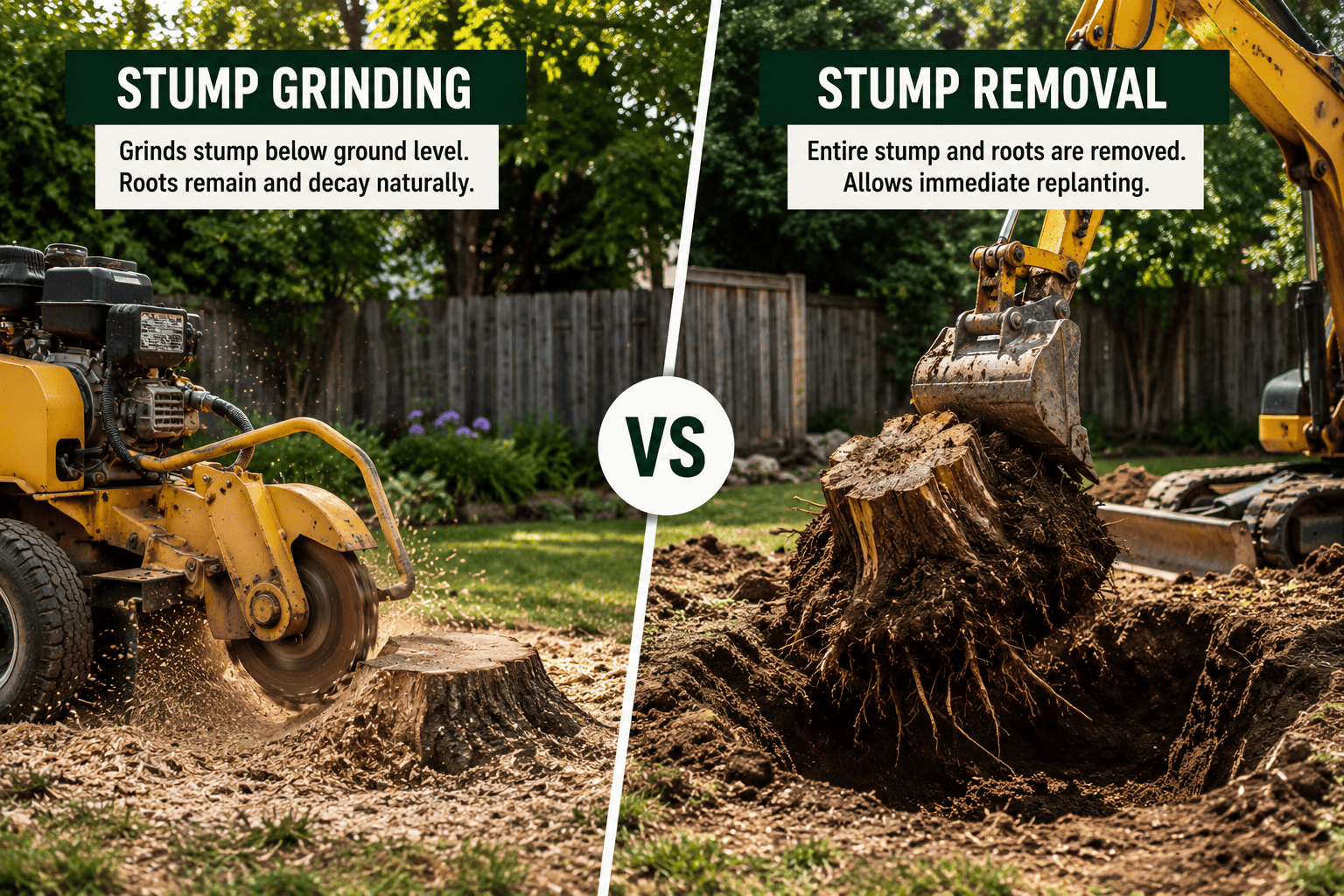
After a tree is cut down, the stump does not go with it. You have two choices: grind it down below ground level with a specialized machine, or extract it entirely – trunk, root ball, and major roots – with excavation equipment. Both eliminate the visible stump, but the methods differ dramatically in cost, yard disruption, and what is possible afterward. If replanting a new tree in the same spot is the goal, the choice matters.
This guide compares the two approaches, explains when each is the right call, and walks through costs and timelines in San Mateo County. Precision Tree Care provides both stump grinding and full stump removal throughout the Peninsula, and our certified arborist (ISA #WE-12520A) helps homeowners decide which method fits their plans without overselling the more expensive option.
What is the difference?
Stump grinding
- A rotating cutter head grinds the stump down to 4 to 12 inches below grade
- Major roots remain in the ground and decay naturally over 1 to 5 years
- Leaves a hole filled with wood chips and soil
- Minimal yard disruption; access just needs to be wide enough for the grinder
- Fast – usually 15 minutes to 3 hours per stump
Stump removal (full extraction)
- The entire stump plus major root ball is dug out with a skid steer or excavator
- All or nearly all roots come with it
- Leaves a large hole – typically 2 to 4 feet across and 2 to 3 feet deep
- Significant yard disruption; equipment access must accommodate a skid steer or excavator
- Slower – usually 1 to several hours per stump, plus backfilling
Cost comparison
| Method | Typical cost | What is included |
|---|---|---|
| Standard stump grinding | $100 – $500 per stump | 4 to 6 inch depth, chips left on site |
| Deep stump grinding | $300 – $800 per stump | 8 to 12+ inch depth, chips left on site |
| Full stump removal (excavation) | $500 – $2,500+ per stump | Complete extraction, backfill with clean soil |
| Skid steer removal of very large stumps | $1,500 – $5,000+ | For stumps 36+ inches diameter or dense root systems |
| Soil restoration after removal | $100 – $400 | Bring in soil, level ground, reseed grass |
Grinding is typically 2 to 5 times cheaper than full removal for the same stump, reflecting the difference in equipment time and disposal.
When grinding is the right choice
- You want a level lawn surface, nothing more complex
- You plan to plant grass, ground cover, or small plants over the area
- You are willing to wait 1 to 3 years for wood chips to fully decompose
- Your access is narrow (narrow side yard, gated backyard) – grinders fit where skid steers cannot
- Budget matters more than speed of replanting
- You do not need the exact spot for a new tree or structure
For the vast majority of residential situations, grinding is the right call.
When full removal is worth the extra cost
- You plan to plant a new tree in the exact same location, soon
- You are building a foundation, patio, shed, or other permanent structure on the spot
- The tree was invasive or diseased, and you want to eliminate any chance of regrowth from roots
- Persistent suckering from species like black locust, poplar, or certain elms is likely
- Roots are actively damaging pipes, foundation, or hardscape and need to be fully traced and removed
For these situations, the higher cost of full removal is usually justified.
Replanting: why the method matters
After grinding
The hole is filled with wood chips mixed with soil. Wood chips decompose over 1 to 3 years, during which they:
- Tie up nitrogen from surrounding soil
- Settle unevenly, leaving depressions
- Provide poor rooting medium for anything but the toughest plants
For planting a new tree directly in the ground spot, you have three options: wait 2 to 3 years for chips to decompose fully; remove the chips and replace with fresh soil (half-measure); or choose a different spot 4 to 6 feet away.
After full removal
The hole is filled with fresh clean soil. A new tree planted in that spot has normal root development conditions and can be planted immediately after backfill settles (a few weeks). This is why full removal is the right call when replanting in the exact spot is important.
Access matters: what equipment can reach the stump
Narrow side yards, locked gates, and steep slopes often rule out the skid steer or excavator required for full removal. A mid-size stump grinder fits through most residential gates; a skid steer needs 48 to 60 inches minimum clearance. In San Mateo County, many Atherton and Hillsborough properties have side yards that accommodate the larger equipment; dense Pacifica and Daly City lots often do not. Your crew should confirm access before quoting.
Disposal of wood and soil
- Grinding: wood chips can stay on site as free mulch, or be hauled away for a small fee ($50 to $200 typically).
- Full removal: the stump and root ball need to go somewhere. Disposal at a green waste facility adds cost; some homeowners keep large stumps as yard features or firewood source.
Precision Tree Care offers free wood chips to customers upon request – useful for garden paths, mulch rings, or weed suppression.
Time: how long each method takes
| Stump size | Grinding time | Full removal time |
|---|---|---|
| Small (under 12 in diameter) | 15 to 30 minutes | 1 to 2 hours |
| Medium (12 to 24 in) | 30 to 90 minutes | 2 to 4 hours |
| Large (24 to 36 in) | 1 to 3 hours | 4 to 8 hours |
| Very large (36+ in) | 2 to 4+ hours | 8+ hours or multi-day |
Permits and local rules
In San Mateo County, stump grinding and removal generally do not require permits on their own – the permit requirements attach to tree removal, not post-removal cleanup. Two exceptions: stumps in the public right of way may need encroachment permits for any excavation work, and grinding near protected trees may require root zone review. When stump work is bundled with a tree removal that required a permit, the stump work is included in that permit’s scope.
DIY: can you do either yourself?
Grinding: yes for small stumps with rental equipment, with safety and utility-location caveats (see the stump grinding depth article). Full removal: generally not DIY unless you own earthmoving equipment and have large-equipment operating experience. Hand-digging a 24-inch stump with an axe and shovel is possible but takes days and is physically demanding. Most homeowners who try quickly decide grinding or professional removal is worth it.
Frequently asked questions
1. Is stump grinding the same as stump removal?
No. Grinding reduces the visible stump to below ground level while leaving major roots in place to decay naturally over 1 to 5 years. Removal extracts the entire stump plus most of the root system with excavation equipment, leaving a large hole that gets backfilled with fresh soil. Grinding is faster, cheaper, and creates less yard disruption. Removal is more expensive and disruptive but leaves the spot ready for immediate replanting or construction.
2. Is it better to grind a stump or remove it?
Depends on your plans. For most residential situations – keeping the lawn level, preventing regrowth, improving appearance – grinding is the better call because it is 2 to 5 times cheaper and causes minimal yard disruption. Full removal is better when you plan to plant a new tree in the exact same spot, build a structure there, or eliminate any chance of regrowth from a species that suckers aggressively. Your crew should be able to advise based on your specific plans without pushing the more expensive option by default.
3. Can I plant a new tree where a stump was ground?
Technically yes, but not ideally. The ground-up wood chips in the hole decompose over 1 to 3 years, tying up nitrogen and providing poor rooting conditions. Three options if you want to replant in or near the same spot: (1) wait 2 to 3 years for chips to decompose; (2) remove the chips and replace with fresh soil after grinding (partial fix); (3) plant the new tree 4 to 6 feet away from the old stump’s location, where soil is undisturbed. For replanting in the exact same location immediately, full stump removal is the right method.
4. Will a stump grow back after grinding?
The stump itself is dead and cannot regrow. But a few species can send up shoots (suckers) from remaining roots for several years: black locust, poplar, some elms, certain fruit trees. If you had one of these, expect occasional shoots for 2 to 5 years that can be cut or treated as they appear. Most tree species – oaks, maples, redwoods, most pines – do not sucker after grinding and give no regrowth problems.
5. How long do roots take to decay after grinding?
Small roots decompose in 1 to 2 years. Medium roots (1 to 3 inches diameter) take 3 to 5 years. Large structural roots can take 5 to 10 years to fully decay. During decomposition, the soil in that area will settle, occasionally requiring topping off with soil. Decomposing roots rarely cause problems – they provide nutrients back to the soil and do not attract termites or other pests unless the tree was already infested.
6. Can a stump grinder remove all the roots?
No. Grinders access the stump and the top 4 to 12 inches of immediately surrounding roots. Major structural roots extending beyond the grinding zone stay in the ground. For most situations this is fine – those roots decay naturally and do not cause problems. For situations requiring complete root removal (structural construction, persistent sucker problems, root damage to pipes), full excavation is needed, not grinding.
7. What is the best professional stump grinder?
For homeowners, the question is less which brand the crew uses and more whether they have equipment matched to your job. A small walk-behind grinder (like a Vermeer SC30TX) works for small stumps and narrow access. A larger self-propelled grinder (SC372 or similar) handles medium stumps faster. A truck-mounted grinder (SC1152, SC1172) handles large stumps and root flares efficiently but needs vehicle access. Professional tree services typically own several sizes and bring the right machine for the job. Ask what equipment they plan to use when getting quotes.
8. Should I hire the same crew for tree removal and stump grinding?
Usually yes – bundling saves 15 to 25 percent compared to separate visits, and a single crew that knows the tree and its root system can handle the whole job more efficiently. Some homeowners separate the two to get competitive stump grinding bids, but the savings rarely outweigh the convenience and bundled discount. At Precision Tree Care, challenging tree removal quotes include grinding as a bundle option at a discount. Free estimates at (650) 355-1277.