
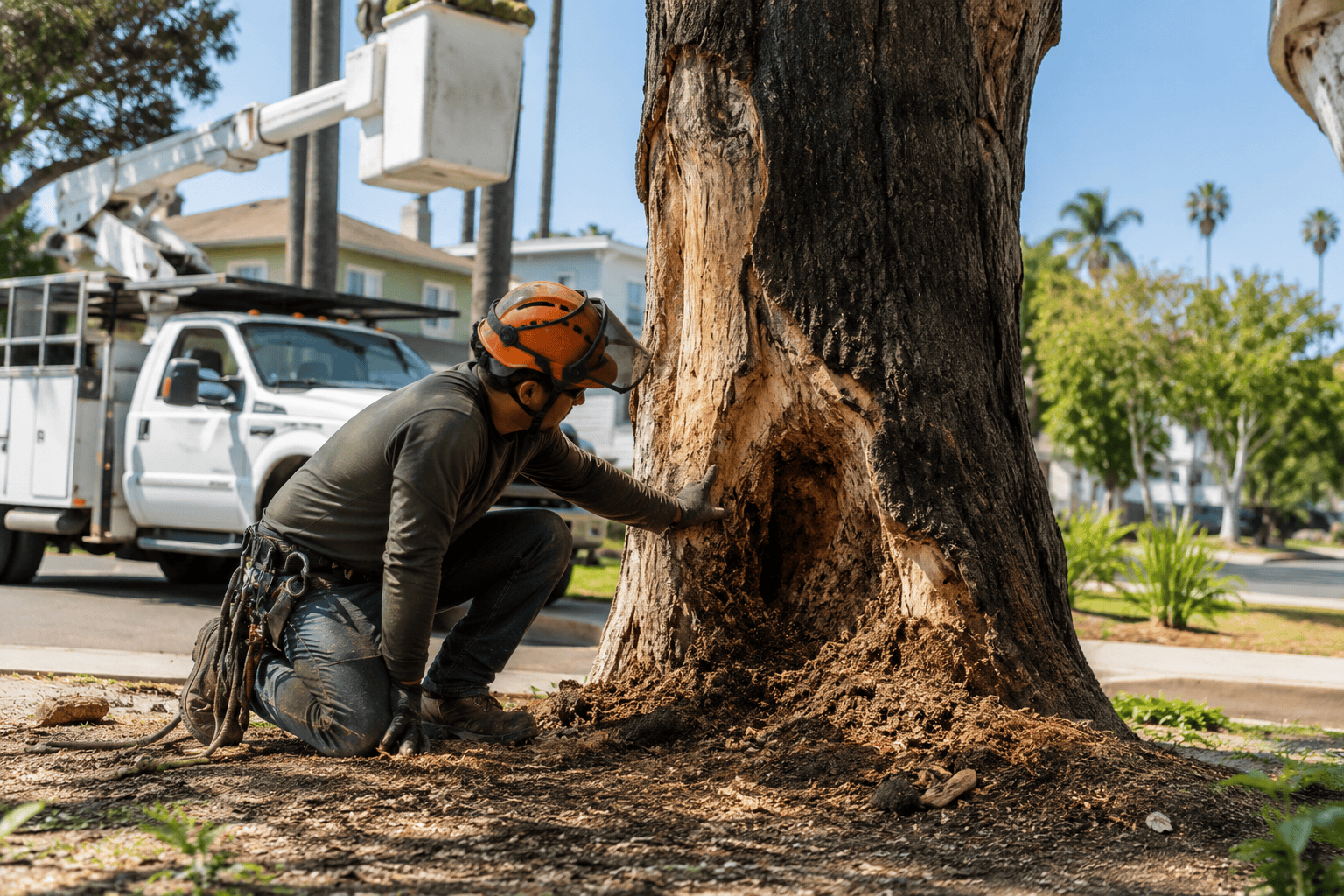
Termites or Ants in Your Tree: Does It Mean the Tree Is Dangerous?
Insects in or around a tree are easy to dismiss, but in some cases they are the visible symptom of hidden structural decay that can turn a healthy-looking tree into a serious hazard. Termites and carpenter ants rarely cause the initial damage – they exploit wood that is already rotting or moisture-damaged. Their presence signals that the tree’s internal structure may be compromised.
This guide explains how to recognize insect activity in trees, how to assess the structural risk, when treatment is possible, and when removal is the safer answer. For trees near homes, driveways, or power lines, a professional evaluation is worth the $150 to $400 cost – decay that is invisible from outside is routine to find with a proper inspection. Precision Tree Care’s ISA Certified Arborist (#WE-12520A) handles these assessments across San Mateo County; call (650) 355-1277 for a free estimate.
Can termites or ants make a tree dangerous?
Sometimes, and the reason is usually indirect. Termites and carpenter ants prefer wood that is already softened by decay, moisture damage, or injury. When you see them, the tree has usually been compromised for years. Ongoing insect activity then accelerates the decline:
- Internal decay expands as insects tunnel deeper
- Structural wood fibers lose load-bearing capacity
- The trunk can become hollow while the bark and outer rings still look intact
- Wind and weight loads concentrate on the remaining sound wood
The result is a tree that appears stable on casual inspection but can fail with little warning, especially during wind events common on the Peninsula from October through April.
How to recognize termite damage in a tree
Termite signs
- Mud tubes running up the trunk or along exposed roots – pencil-width tunnels of soil and wood pulp
- Hollow sound when the trunk is tapped with a mallet or even a knuckle
- Small exit holes (about 1/16 inch) in bark or dead wood
- Frass – fine, sawdust-like droppings at the base of the tree or in bark crevices
- Peeling or blistering bark that separates easily from the wood underneath
- Winged swarmers around the base in spring – often mistaken for flying ants
Carpenter ant signs
- Large black or reddish-black ants coming and going from a consistent spot
- Coarse sawdust (frass that looks more like shavings) at the tree base
- A faint rustling or crunching sound from inside the trunk on warm days
- Ants appearing inside the house near the tree – often the first thing homeowners notice
Unlike termites, carpenter ants do not eat wood. They excavate it for nesting, which still removes structural material, just more slowly.
Warning signs that the tree is failing
Insect activity combined with any of these markers is a strong signal the tree needs professional assessment:
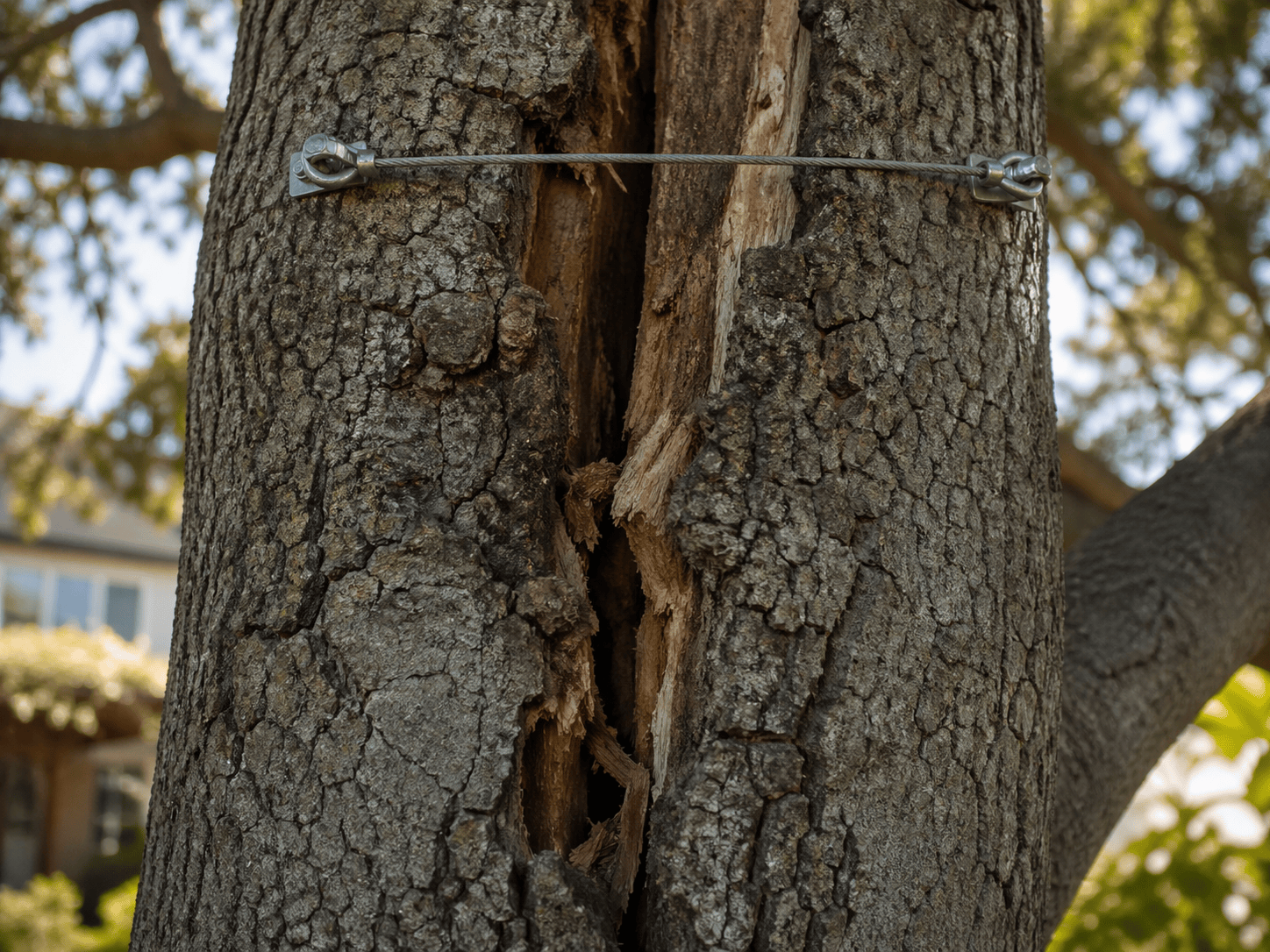
- Cracks or splits running vertically up the trunk
- A noticeable lean that has developed or worsened recently
- Dead or dying branches in the upper canopy
- Fungal brackets or mushrooms growing on the trunk or at the root flare
- Soft or crumbling wood that can be dug into with a screwdriver
- Visible hollows or cavities
- Soil cracks or lifted root plate
Two or more of these together in a tree with insect activity is a tree that should be inspected now, not next season. A written arborist report documents the condition for insurance and permit purposes.
What happens inside a decaying tree
The wood loses strength from the inside out. An outer shell of apparently healthy wood can surround a substantially hollow core, and the tree may still look fine to a passerby. Hollowing becomes critical for safety when:
- More than one-third of the trunk’s cross-section is compromised at any point
- Decay extends into major branch unions or the root flare
- Multiple cavities connect internally
- The tree has significant weight above the decay zone
A certified arborist can estimate internal soundness using sounding mallets, resistograph drilling, or tomography in advanced cases. Most residential assessments rely on visual inspection combined with targeted probing, which catches the vast majority of dangerous decay.
Treatment versus removal
Treatment may be possible when
- Insect activity is caught early
- Structural damage is minimal and localized
- The tree is otherwise healthy and vigorous
- The species has good compartmentalization (healthy oaks, many hardwoods)
Treatment typically combines targeted pest control by a licensed PCO, removal of dead wood and decayed branches by a certified arborist doing proper fine pruning, and improved growing conditions (watering, mulching properly, avoiding soil compaction).
Removal is the right call when
- More than one-third of the trunk cross-section is compromised
- Decay is active in the root flare
- The tree is leaning or shows clear failure signs
- The tree is close to a house, driveway, or power line where failure would cause major damage
- Fungal brackets indicate extensive internal rot
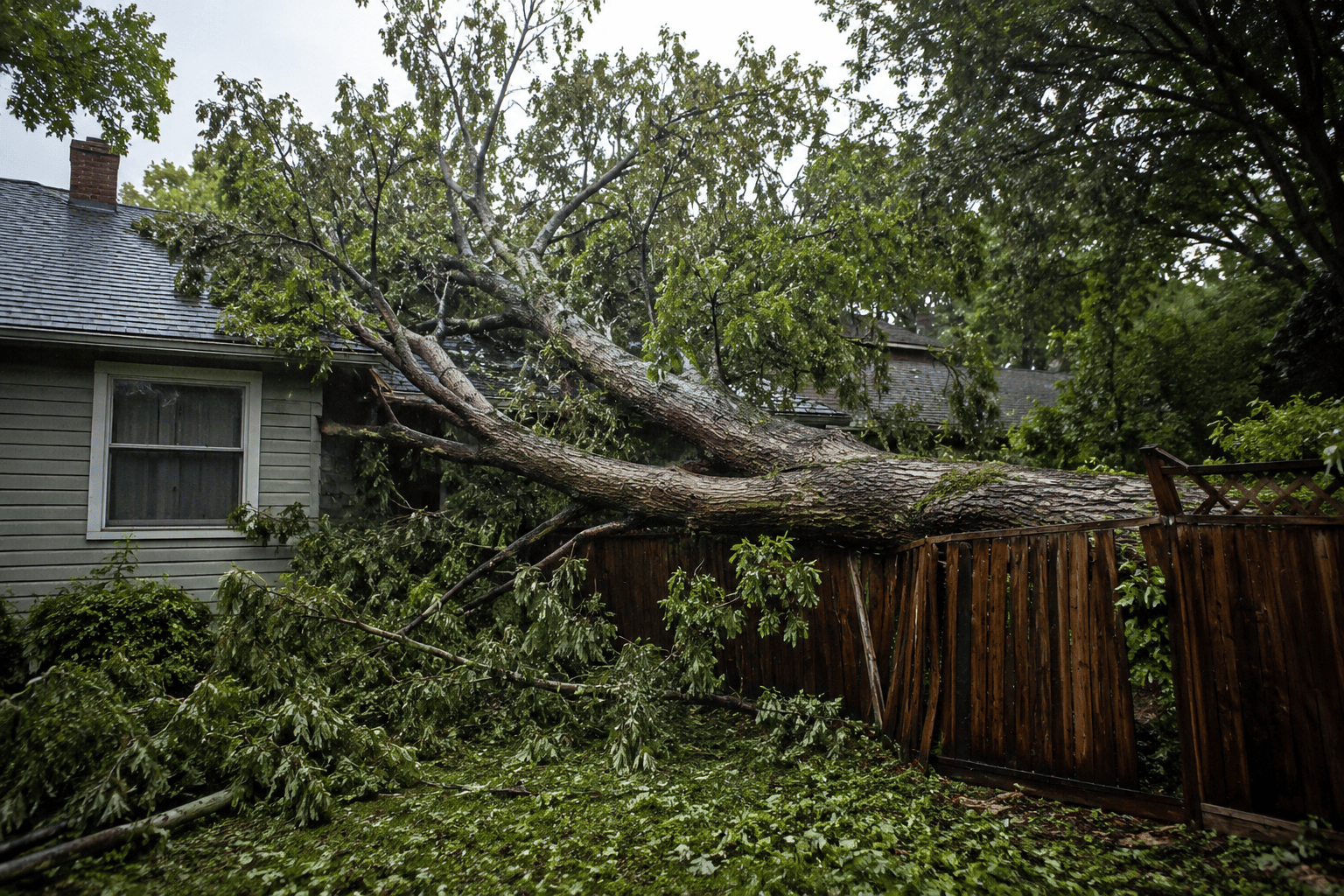
For trees of this condition, safe professional removal is not optional. Decayed trunks are unpredictable under saw – they can kick back, drop load unexpectedly, or crush onto adjacent structures.
Costs: inspection, treatment, removal
| Service | Typical cost | Notes |
|---|---|---|
| Visual tree inspection | $100 – $300 | Certified arborist walkaround |
| Written arborist report | $150 – $500 | Documented assessment for insurance or permits |
| Pest treatment (licensed PCO) | $200 – $800 | Separate service from tree care |
| Selective dead wood removal | $300 – $1,200 | Fine pruning of affected limbs |
| Full tree removal (decay compromised) | $800 – $3,500 | Includes rigging, haul, dump |
Local rules for removing trees with decay
Protected species in San Mateo County still require a permit even when the tree is showing obvious structural failure. The imminent hazard exception applies if the tree is in active failure – leaning, splitting, branches dropping – but a certified arborist’s written assessment is almost always required. For non-emergency removal of a decayed but stable protected tree, budget 2 to 6 weeks for the permit process and include the arborist report with your application.
Preventing future insect and decay problems
- Annual visual inspections by a certified arborist catch decay early
- Avoid wounds to the trunk – mower damage, string trimmer scars, and construction equipment impacts all create entry points
- Proper mulching: 2 to 3 inches of mulch, kept away from the trunk flare; avoid “volcano mulching”
- Good drainage – standing water around the base encourages the moisture conditions insects prefer
- Prompt removal of dead branches before they become nesting habitat
- Do not stack firewood against living trees
Frequently asked questions
1. Do termites or ants always mean a tree is dangerous?
Not always, but often they indicate underlying decay that needs professional evaluation. Light activity in a dead branch of an otherwise healthy tree is not an emergency; heavy activity in the main trunk, combined with cracks, leans, or fungal growth, is. The test is what else you see on the tree. An ISA Certified Arborist can distinguish cosmetic from structural infestation in a 20 to 30 minute visual inspection.
2. What are the earliest signs of termites in trees?
Mud tubes running up the trunk are the classic early sign – look for them in spring when termites are most active. Small (1/16 inch) holes in the bark, fine sawdust-like frass at the base, and a hollow sound when the trunk is tapped are other early markers. If you see swarming winged insects around the tree in spring, have it inspected within a few weeks – termite swarms indicate an established colony inside.
3. Can a hollow tree still be safe?
Sometimes, depending on how much wood is compromised and where. Trees can survive with a surprisingly hollow trunk as long as enough sound wood remains in the outer rings – typical failure threshold is when more than about one-third of the cross-section is compromised, or when decay reaches the root flare or a major branch union. Location also matters: a hollow tree in open space away from structures is a different risk profile from the same tree over a house. A resistograph drill test or tomography can quantify internal soundness when it matters.
4. Are carpenter ants as destructive as termites?
Not as destructive pound for pound – ants excavate, termites consume. But carpenter ants still remove wood to create nest galleries, and they often signal advanced decay conditions that will keep getting worse. Ants coming into the house from a tree is also a real nuisance problem. Treat them seriously, just with somewhat less urgency than a confirmed termite colony.
5. Can I treat termites or ants in a tree myself?
Not effectively. Over-the-counter insecticides might knock down visible foragers but do not reach colonies inside the tree. Pressurized foam and dust treatments used by licensed pest control operators are more effective, and they will also advise whether the tree can be saved. This is a team situation: a licensed PCO handles the insects, a certified arborist handles the tree. They often coordinate on larger properties. DIY spray-and-pray rarely solves the underlying decay problem.
6. How do I prevent termites from entering my trees?
Limit what attracts them. Keep mulch 2 to 3 inches deep and pulled back from the trunk flare – termites love soggy mulch piled against bark. Fix irrigation that is keeping the root zone perpetually wet. Do not stack firewood against living trees; wood piles are nurseries for termites. Avoid wounding the trunk with mowers and string trimmers. And do not let dead limbs accumulate in the canopy – they are free real estate for colonies.
7. Should I remove a tree if I find termites near my house?
Depends on the tree’s condition and its proximity to the house. If the tree is structurally sound and the termite activity is in dead branches, targeted pest treatment plus dead wood removal may be enough. If the tree has structural decay in the trunk or root flare and is within striking distance of your house, removal is usually the safer call. Termites in a tree within 20 feet of a house also raise the risk of them discovering your wood framing – a licensed PCO should inspect the structure as well.
8. How much does it cost to inspect a tree with suspected termite damage?
A standard visual inspection with verbal recommendations runs $100 to $300. A written arborist report documenting the tree’s condition, the damage, and the recommended action costs $150 to $500 – needed for insurance claims, permit applications, or any disputed situation. More advanced diagnostics (resistograph, tomography) cost $300 to $800+ and are used when the financial or legal stakes justify the detail. Free estimates for inspection and removal in San Mateo County at (650) 355-1277.