
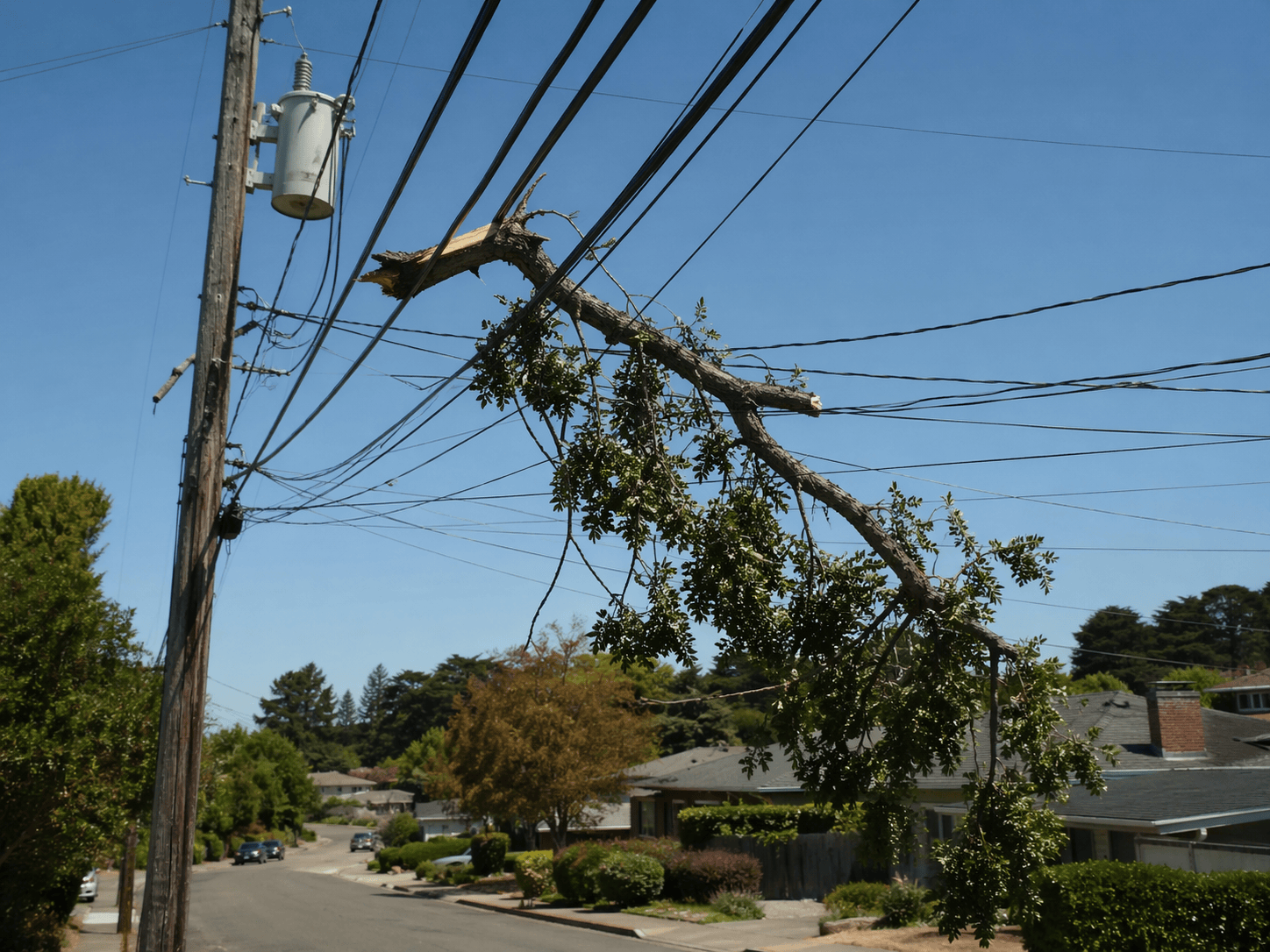
A tree on a power line is one of the few yard problems where the right move is to do nothing yourself. If a tree or branch is touching, leaning on, or has fallen onto a power line, stay well away, keep everyone else and pets away, and call 911 if the line is down or sparking. Then call PG&E at 1-800-743-5000. PG&E or its line-clearance contractor handles anything within 10 feet of an energized line; a licensed arborist removes the rest of the tree once the line is safe or de-energized.
This guide explains the PG&E rules that apply in San Mateo County: which lines PG&E trims and which ones you are responsible for, how to get a free temporary disconnect before any work near the wire to your house, what the clearance rules under CPUC General Order 95 actually require, and how our crew removes a tree near lines without anyone touching an energized conductor. If a tree has already come down and caused damage, our 24/7 emergency tree service is the number to call after PG&E has made the line safe.
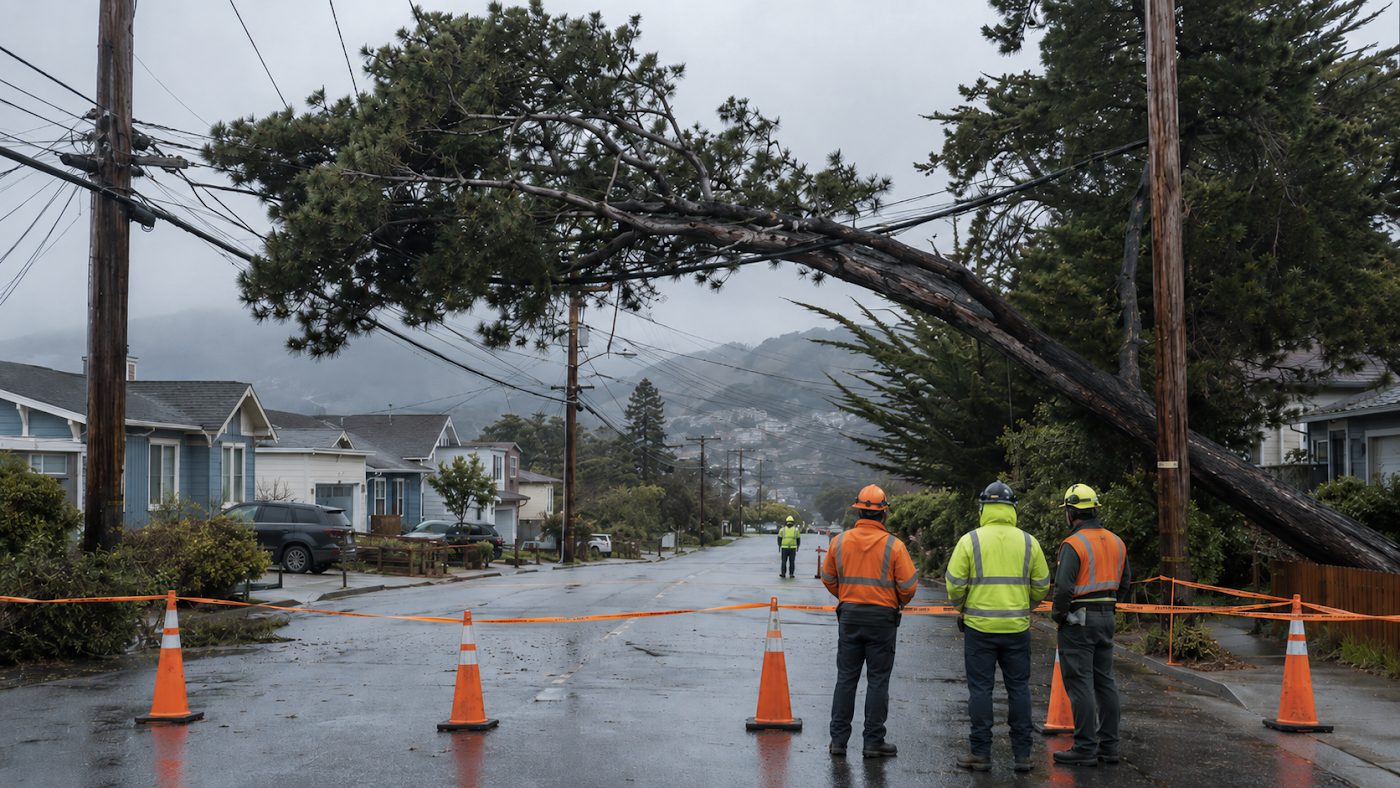
What to do right now if a tree is on a power line
Treat every wire as live, including the wire running from the pole to your house. A branch does not need to be sparking to be dangerous – wet bark, green wood, and the ground around a downed line can all carry current. Follow these steps in order:
- Move away and keep others away. Do not approach the tree, the line, a fence or gutter the line is touching, or a puddle near it. Keep children and pets indoors.
- Call 911 if the line is on the ground, arcing, smoking, on a car, or on a structure. This is an emergency call, not a “report it later” call.
- Call PG&E at 1-800-743-5000 to report the tree contact and any outage. PG&E dispatches its own crew or a qualified line-clearance contractor to make the line safe.
- If a line falls on your car, stay inside it. The ground around the vehicle may be energized. Call 911 from inside and wait for utility or fire personnel to tell you it is safe to get out.
- Do not use a pole saw, ladder, or chainsaw anywhere near the tree. Do not try to pull the branch off with a rope, and never spray water toward the line.
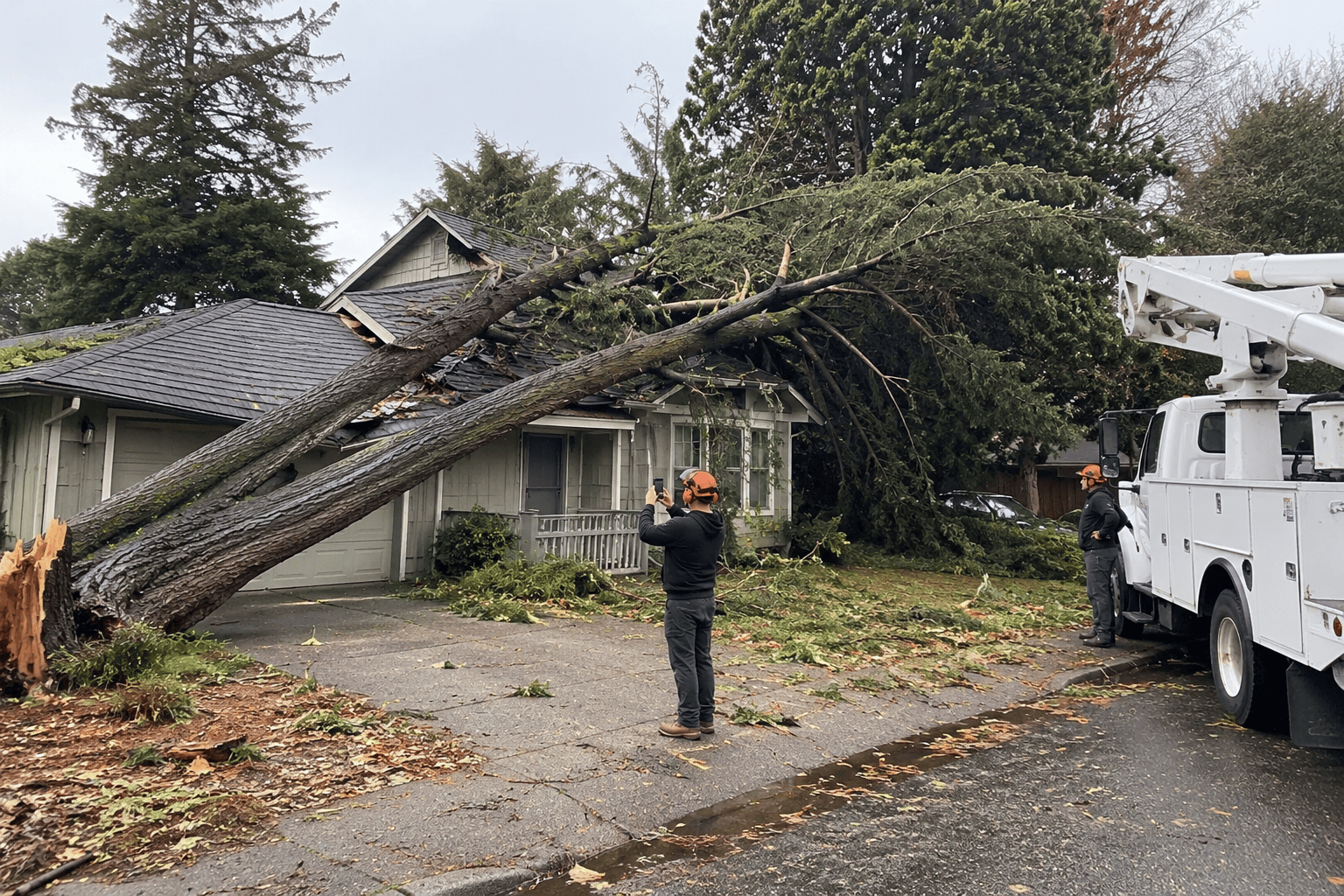
- Take photos from a safe distance for your insurance file, then call a licensed arborist about the part of the tree that is not in contact with the line.
PG&E’s own electric safety guidance is blunt about the first rule:
“Always assume that a fallen powerline is live.”
– PG&E, Electric Safety guidance
On the same page PG&E tells anyone whose vehicle contacts a downed line to “Stay inside your car. The ground around your car may be energized” and to “Call 9-1-1 from your car, if possible.” The only time to leave the car is if it catches fire, and then by jumping clear without touching the car and the ground at the same time, then shuffling away with your feet close together.
Who is responsible for trees near power lines: PG&E or the homeowner?
The confusion usually comes from the fact that there are two very different kinds of wire on a typical San Mateo County lot. PG&E trims around the high-voltage lines that run pole to pole. The homeowner owns the vegetation around the service drop, which is the lower wire that runs from the pole to the house. The table below is how our arborist explains it on site.
| Type of line | Who is responsible for clearance | What to do |
|---|---|---|
| Transmission lines (tall steel or wood towers, very high voltage) | PG&E | Report vegetation contact to PG&E; never work anywhere near these lines |
| Distribution primary lines (the top wires on neighborhood poles, 2,400 to 72,000 volts) | PG&E, under CPUC General Order 95 and PRC 4293 | Report through PG&E Report It or 1-800-743-5000; PG&E’s line-clearance contractor trims to the required clearance at no charge |
| Distribution secondary lines (lower wires on the pole, 120/240 volts, often bundled) | PG&E maintains the line; tree work near it still requires a qualified worker | Report contact to PG&E; a licensed arborist handles the rest of the tree outside the 10 ft zone |
| Service drop (wire from the pole to your house or meter) | Property owner | Ask PG&E for a free temporary disconnect, then have a licensed arborist do the pruning or removal |
| Downed line of any kind | PG&E and first responders | Call 911, then 1-800-743-5000; stay away until PG&E confirms the line is safe |
| Cable, phone, or fiber lines (lowest wires on the pole) | The telecom company, not PG&E | Still treat as unknown until confirmed; an arborist can usually work around them once identified |
PG&E states the homeowner side of this directly on its vegetation management page:
“Service drops are electric wires that carry electricity from the pole to a home or business. Property owners are responsible for keeping service drop wires clear of vegetation and dead or hazardous trees.”
– PG&E, Vegetation Management
The same page answers the next question most homeowners ask, which is how you are supposed to keep that wire clear without touching it: “If you need to work near service drop wires, you can ask us to disconnect your electric service for a short time.” PG&E calls this a free, temporary service disconnect, and it is requested through the Start/Stop Service section of your PG&E account. We schedule our service-drop jobs around that disconnect window.

PG&E clearance rules: General Order 95 and PRC 4293 in plain words
Two rules drive PG&E’s trimming program. CPUC General Order 95 is the California Public Utilities Commission rule that, in PG&E’s words, “requires minimum clearance between trees and powerlines year-round.” California Public Resources Code section 4293 adds a fire-safety clearance in State Responsibility Areas, which PG&E summarizes as a 4-foot minimum clearance for lines carrying between 2,400 and 72,000 volts.
In practice, PG&E says it maintains a minimum of 18 inches of clearance around distribution primary lines in ordinary areas and a minimum of 4 feet in High Fire-Threat Districts. The crews typically trim beyond the minimum so the tree does not regrow into the line before the next inspection cycle. That is why a PG&E cut sometimes looks heavier than a homeowner expected – the contractor is pruning for the next few years of growth, not for the tree’s shape.
Two points matter for your own planning. First, these clearances are PG&E’s obligation on the primary lines, not a distance you are allowed to work to. PG&E’s guidance for anyone doing yard work is simpler: “Keep your body and tools at least 10 feet away from powerlines.” Second, PG&E’s trimming is limited to clearance for the line. It does not prune your tree for health, remove the rest of a hazardous tree, grind the stump, or haul the wood away in most cases. That part is the property owner’s job, and it is where a licensed arborist comes in.
Can you trim a tree near a power line yourself?
Not if any part of the tree or your tools would come within 10 feet of the line, and in our view not at all when the tree is already touching it. California treats work within that zone as line-clearance work that only trained, qualified tree workers may perform, and general tree companies that are not on a utility line-clearance program do not do it either. A pole saw is an aluminum conductor with a handle. A ladder against a tree that is leaning on a wire moves when the tree moves.
What you can safely do from the ground:
- Identify which wire the tree is touching. The service drop enters near your meter; primary lines are the highest wires on the pole.
- Report vegetation growing into PG&E’s lines through PG&E Report It or by phone, even if nothing has failed yet. PG&E inspects and trims those lines on a schedule, but a report moves a hazard up the list.
- Request the free temporary disconnect if the problem is on your service drop, then book a licensed arborist for the disconnect window.
- Photograph the contact point and any damage from a safe distance for your records.
Once PG&E has cleared or de-energized the line, the rest of the tree is normal arborist work – but it is often not normal in any other sense. A tree that has been pushed off balance by a storm, or that has grown around a wire for years, usually needs sectional dismantling with rigging or an aerial lift rather than a straight felling cut. That is the reason we treat these as challenging tree removals from the first phone call.
Tree on a power line in San Mateo County: what is different here
Most of what ranks online for this topic comes from utilities in the Midwest or the Northeast. The rules above are California-specific, and the conditions on the Peninsula change how often the problem shows up and how it gets solved.
Hillside and wooded lots
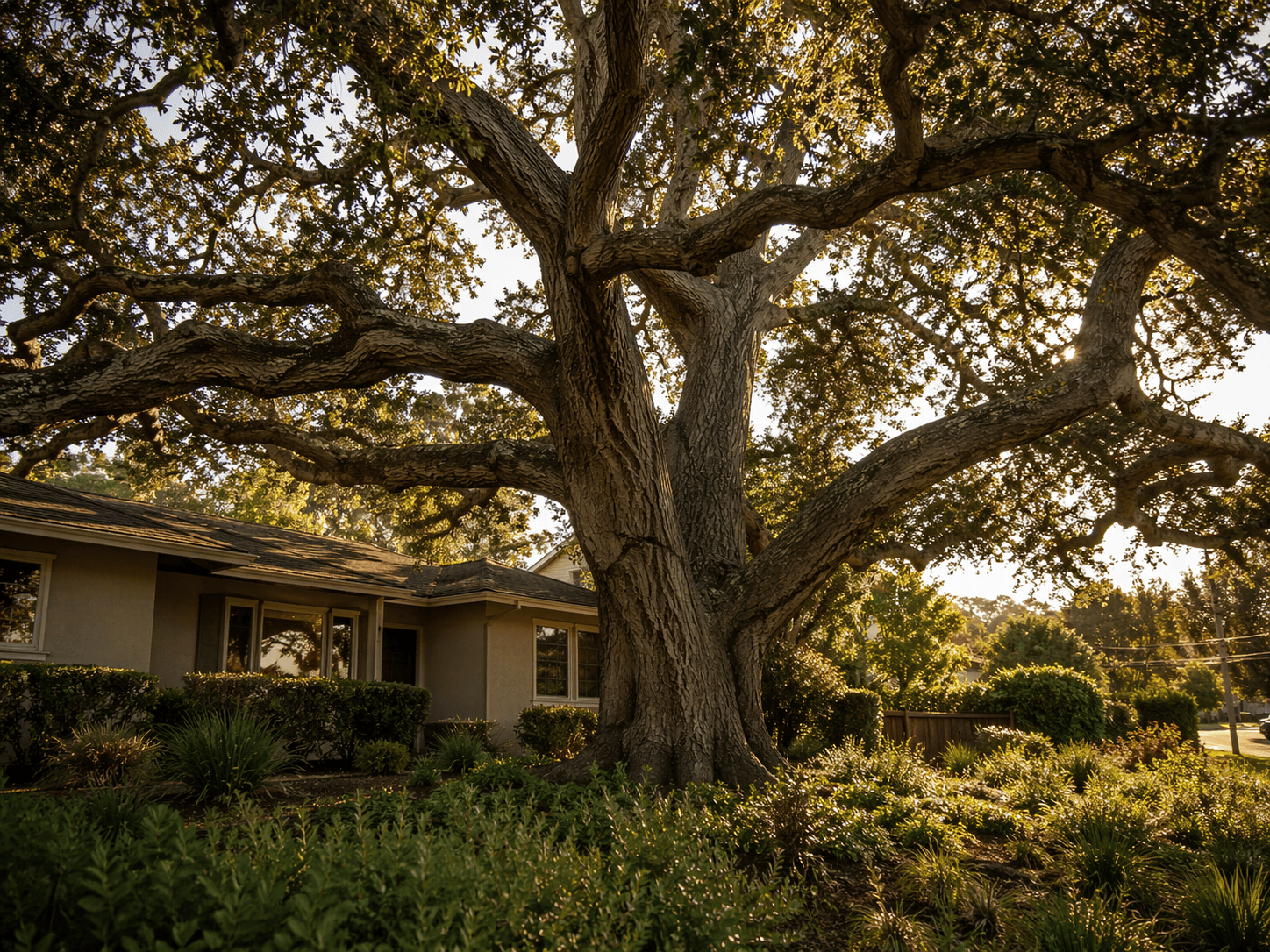
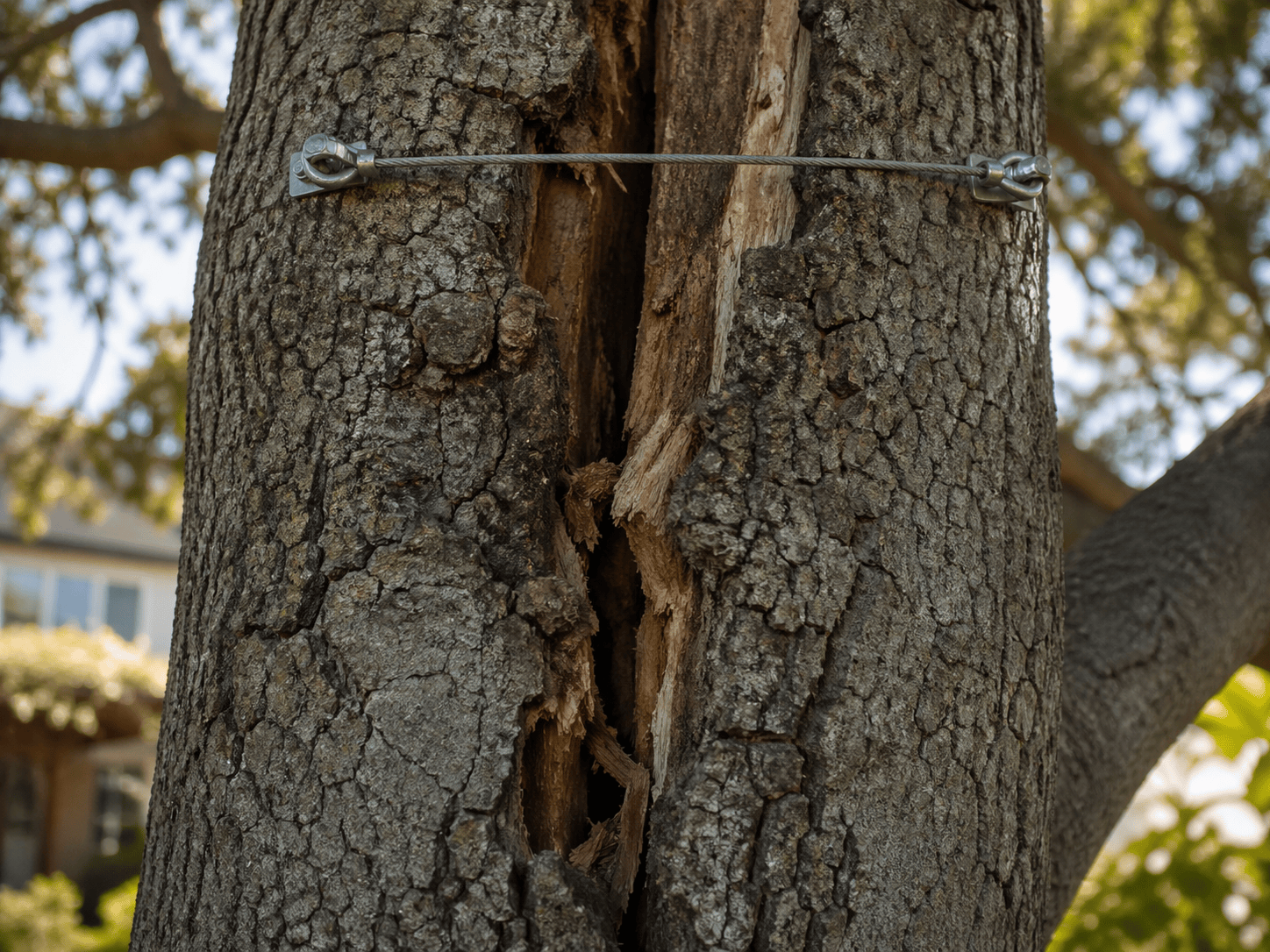
Large parts of Hillsborough, La Honda, Woodside-adjacent canyons, and the Skyline corridor sit inside PG&E’s High Fire-Threat District, where the 4-foot clearance applies and PG&E patrols more aggressively. These lots also have the tallest trees – coast redwood, Douglas fir, eucalyptus, and Monterey pine that overtop the lines by 60 feet or more. A tree can be well outside the clearance zone at the trunk and still be a strike risk if it fails toward the line. That overhang risk is what PG&E’s tree crews look for, and it is what our arborist rates in a TRAQ assessment when a homeowner asks whether a big tree near a line should be reduced, cabled, or removed. Many of these properties are also under Cal Fire defensible space rules, so power-line clearance and fire prevention work are usually planned as one job.
Coastal wind in Pacifica, Montara, and Half Moon Bay
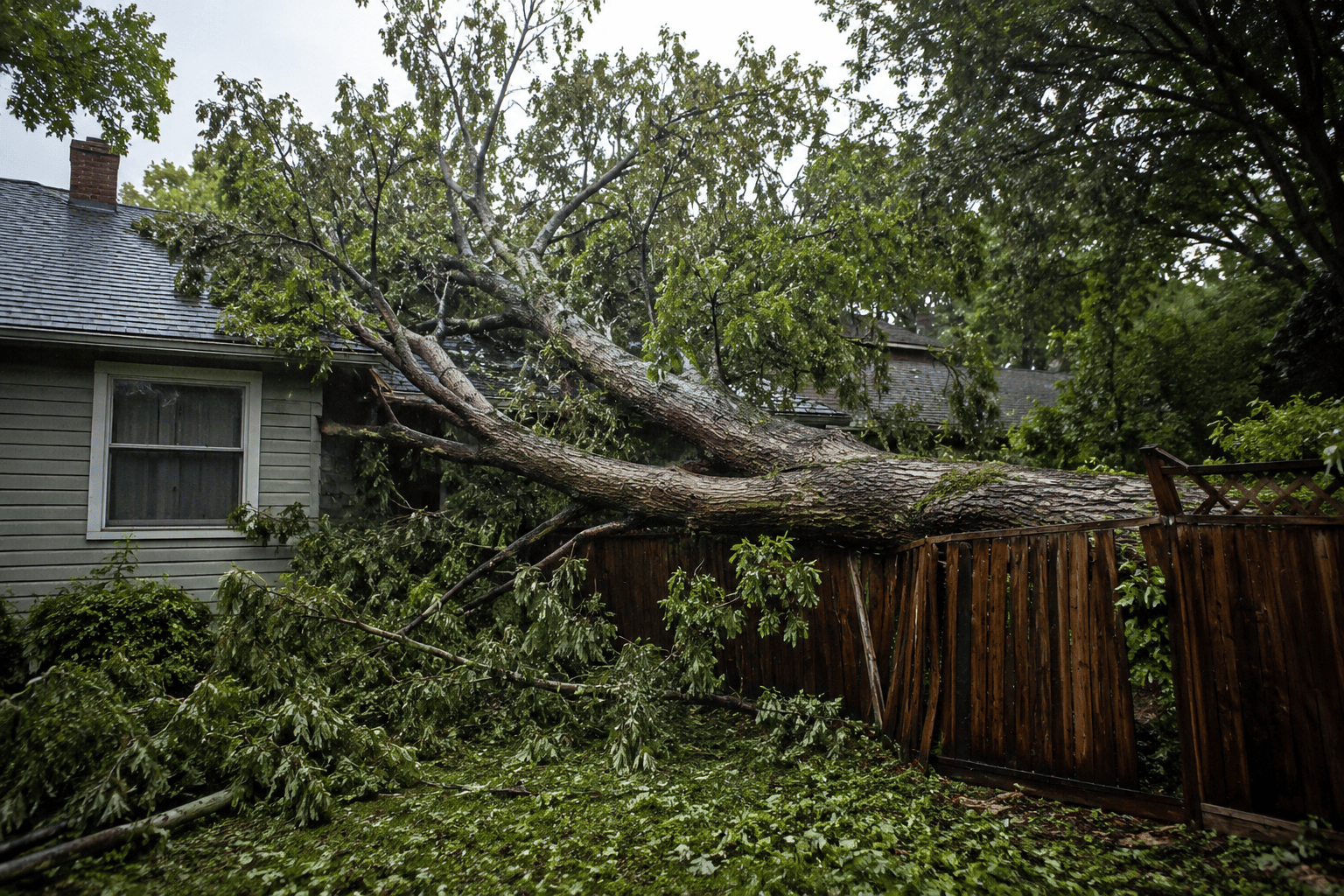
On the coast the problem is less about slow growth and more about sudden failure. Salt-stressed Monterey cypress and pine in Pacifica, Montara, and Half Moon Bay carry dead wood that sheds in winter storms, and a limb that lands on a service drop can pull the wire and the mast off the house. Homeowners in Pacifica call us most often in the week after an atmospheric river. Pre-storm crown thinning on the windward side is the least expensive version of this job; a wire down on the roof is the most expensive.
PSPS outages and enhanced powerline safety settings
In fire season PG&E may turn off power in a Public Safety Power Shutoff, and in high-risk areas its lines run on Enhanced Powerline Safety Settings that trip the circuit within a fraction of a second when something touches the wire. For a homeowner this means a branch brushing a primary line can now cause an outage for the whole street, not just a scorched branch. If your power drops during a wind event and you can see a tree on the line from your window, report it to PG&E rather than assuming a neighbor already has.
Permits still apply
PG&E’s line-clearance work is exempt from most local tree permits, but your own removal of the rest of the tree is not. Many San Mateo County cities protect trees above a set trunk size, and heritage-tree cities such as Atherton, Menlo Park, Palo Alto, and Hillsborough will want an arborist letter before a large removal. Most cities have a faster hazard pathway when a tree has failed or is leaning on a line. Our arborist writes that letter, and our guide to protected trees in San Mateo County covers the process city by city. Never assume no permit is needed – ask the city or ask us.

Who pays when a tree falls on a power line?
It depends on which line and whose tree. If PG&E’s line-clearance contractor trims your tree to meet the General Order 95 clearance, PG&E pays for that trimming. If a tree on your property brings down your service drop, PG&E reconnects the drop, but the mast, weatherhead, and meter panel on the house are typically the homeowner’s, and a licensed electrician has to repair them before PG&E will reconnect. The tree removal itself is on the property owner.
Homeowner insurance policies generally cover damage to the house from a fallen tree and often carry a capped tree-removal benefit when the tree hit a covered structure; a tree that falls into the yard without hitting anything is usually not covered. Policies vary, so confirm with your insurer. The photos you take from a safe distance on day one matter here – our guide to fallen tree insurance claim photos and documents lists what adjusters ask for. If the tree came from a neighbor’s yard, responsibility usually turns on whether the tree was known to be hazardous, which is where a written arborist report earns its keep.
As for our side of the cost: small tree removals in San Mateo County typically run about $300-$600 and large or hazardous removals $1,000-$3,000+, and every estimate includes removal, dumping, and hauling. A tree near lines sits at the higher end because of the sectional work and coordination involved. Those are typical ranges, not quotes – a free estimate is the only accurate number.
Preventing the next call: planting and pruning near lines
The trees that end up on lines in San Mateo County were mostly planted under them decades ago. If you are replacing a removed tree, keep anything that matures above 25 feet well away from the pole line and never directly beneath it. For existing trees, a crown reduction or directional pruning done early keeps the tree growing away from the wire instead of into it, and it avoids the heavier utility cut later. Pruning to keep a limb off the roof and off the service drop is usually the same job; our post on a hanging tree branch over the roof explains when that becomes urgent.
Dead wood is the other repeat offender. A dead limb over a wire will come down in the first strong wind, and PG&E’s page specifically names “dead or hazardous trees” near service drops as the owner’s responsibility. An annual look at any tree within striking distance of a line, especially eucalyptus, Monterey pine, and cypress, is cheap insurance before the winter storm season.
How Precision Tree Care handles a tree on a power line
We do not work on energized lines, and we do not send anyone within 10 feet of one. What we do is everything else, in a sequence that keeps the utility work and the tree work separate:
- Assessment. Our ISA Certified Arborist identifies which line is involved, whether it is PG&E’s or your service drop, and how the tree is loaded. On leaning or storm-damaged trees we note the TRAQ risk rating so you have it for the city or the insurer.
- Coordination with PG&E. For a service drop we help you request the free temporary disconnect and schedule the job inside that window. For a primary-line contact we wait for PG&E’s line-clearance crew to clear the wire, then take over.
- Removal outside the clearance zone. Our 75 ft aerial lift lets a climber dismantle the tree from the side away from the line, piece by piece, with each section rigged and lowered rather than dropped. Where the lift cannot reach – steep hillside lots in La Honda or tight coastal side yards – we climb and rig from the tree.
- Documentation. If the removal needs a permit, our arborist writes the hazard letter. If it is an insurance claim, we provide the written assessment and an itemized invoice.
- Clean-up. We chip, haul, and grind the stump if you want it gone, and we leave the property spotless – no debris, no mess, no worries.
Precision Tree Care has served San Mateo County since 2005, with 40+ years of family expertise behind the crew. Our work is led by an ISA Certified Arborist (#WE-12520A), we hold California Contractors License #907593, and we carry full liability and workers’ compensation insurance – so PG&E, a permit office, or an insurer can rely on our documentation. If a tree has already come through the roof, start with our guide on what to do when a tree fell on the house, then call us.
Tree on a power line or leaning toward one?
Call 911 and PG&E first if a line is down. Then call us for the tree – we coordinate the disconnect, remove the tree safely outside the clearance zone, and handle the paperwork. Free estimates, no hidden fees – removal, dumping, and hauling included.
Request a Free Estimate
or call (650) 355-1277 – 24/7 for emergencies
Frequently asked questions
What should I do if a tree is on a power line?
Stay away from the tree and the line, keep people and pets clear, and call 911 if the line is down, sparking, or on a car or structure. Then report it to PG&E at 1-800-743-5000. Do not touch the tree or try to cut it. Once PG&E has made the line safe, a licensed arborist can remove the rest of the tree.
Who do I call for a tree touching a power line in San Mateo County?
Call PG&E at 1-800-743-5000, or use PG&E Report It, for a tree in contact with PG&E’s pole-to-pole lines. Call 911 first if the line is down or arcing. For the service drop to your own house, PG&E will disconnect the power for free so a licensed arborist like Precision Tree Care can do the work.
Who is responsible for trimming trees near power lines in California?
PG&E is responsible for keeping trees clear of its high-voltage distribution and transmission lines under CPUC General Order 95 and Public Resources Code 4293. The property owner is responsible for the service drop, the wire from the pole to the house, and for any dead or hazardous tree near it, using a free temporary disconnect from PG&E when work is needed.
Does PG&E trim trees for free?
Yes, for its own lines. PG&E’s line-clearance contractors trim vegetation to the required clearance around distribution and transmission lines at no charge, and they will not bill you for that work. PG&E does not prune your tree for health or shape, remove the rest of a tree, grind stumps, or haul wood in most cases, and it does not trim around your service drop.
How far away should I stay from a downed power line?
As far as you reasonably can, and never within the 10 feet PG&E tells homeowners to keep between their body, tools, and any powerline. PG&E’s rule is to always assume a fallen line is live, including the ground and any fence, gutter, or puddle it touches. Call 911, then PG&E, and wait for a crew to confirm the line is safe.
Can I cut a tree branch that is touching the power line to my house?
Not while the line is energized. Ask PG&E for a free temporary service disconnect through Start/Stop Service in your account, and have a licensed arborist do the pruning during that window. Even a low-voltage service drop can injure or kill, and a branch under tension can pull the wire and the mast off your house when it is cut.
Who pays if a tree falls on a power line?
PG&E pays to trim and clear its own lines and to reconnect a service drop. The property owner pays to remove the tree and to repair the mast, weatherhead, or meter panel on the house, with a licensed electrician doing the electrical repair. Homeowner insurance often covers structure damage and a capped tree-removal amount when a covered structure was hit; policies vary, so check yours.
How much does it cost to remove a tree near power lines in San Mateo County?
Typical ranges in San Mateo County are about $300-$600 for a small tree and $1,000-$3,000+ for a large or hazardous removal, with removal, dumping, and hauling included in every Precision Tree Care estimate. Trees near lines usually land at the higher end because they are dismantled in sections. Request a free estimate for an exact figure.