
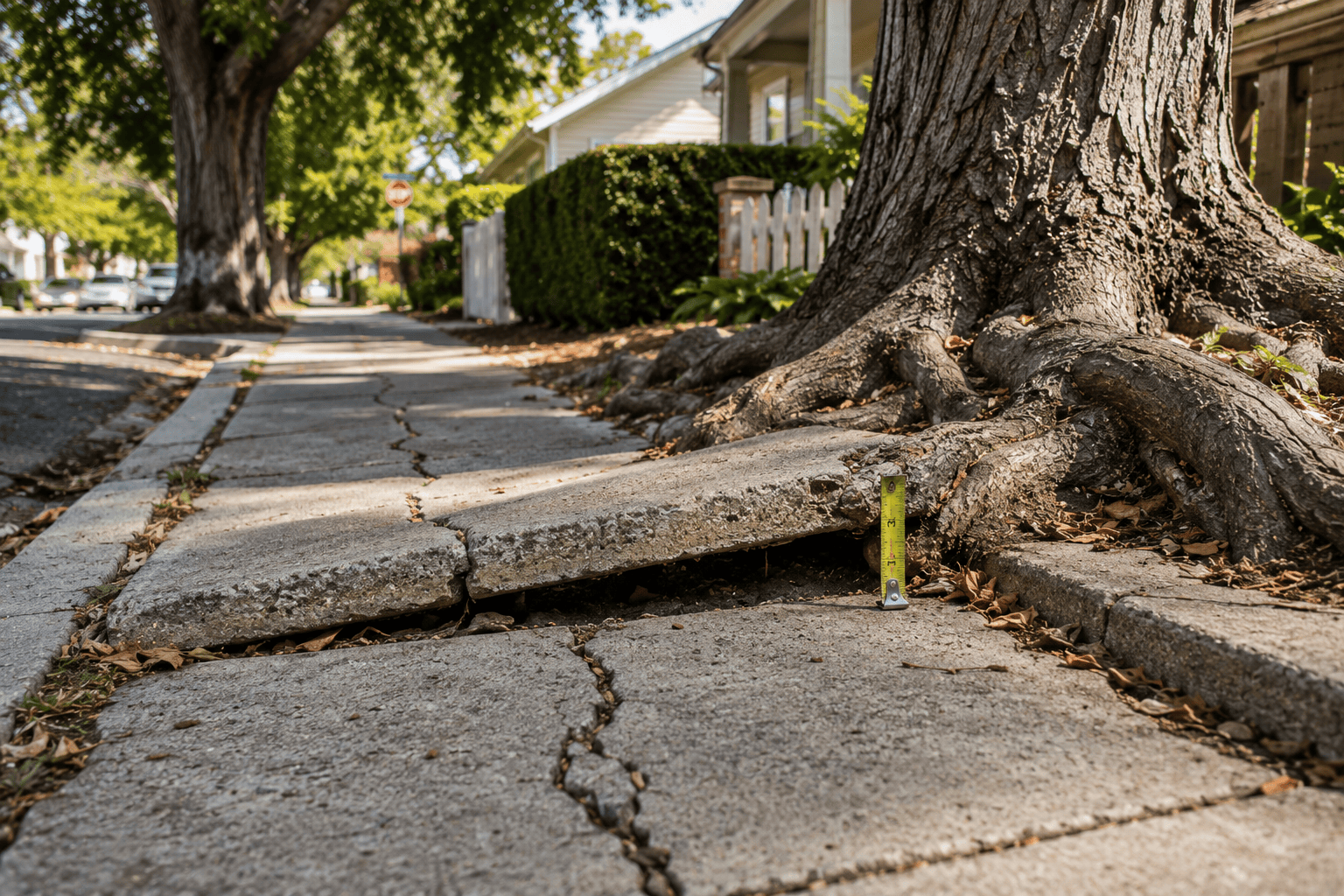
Tree Roots Lifting Sidewalk or Driveway: Fix Options and When It Becomes a Hazard
A sidewalk that has been pushed up by tree roots is more than an eyesore – it is a tripping hazard and, in most California cities, a liability the homeowner is legally responsible for. San Mateo County cities enforce sidewalk maintenance rules under state Streets and Highways Code, which puts the repair burden on the adjacent property owner even when the roots belong to a city-owned parkway tree. Understanding the options, costs, and timelines helps you resolve the problem before it becomes a lawsuit.
This guide explains how to evaluate root damage severity, repair options from simple grinding to full replacement with root barriers, local regulations, and how to handle the tree side without killing it. For professional root management on the tree side – including crown reduction and thinning to reduce growth pressure – Precision Tree Care’s ISA Certified Arborist (#WE-12520A) works alongside concrete contractors on coordinated repairs throughout San Mateo County.
When a lifted sidewalk becomes a legal hazard
California sets specific thresholds for when a sidewalk counts as a hazard requiring repair:
- Vertical displacement of 3/4 inch or more between adjacent slabs – the ADA accessibility threshold
- Cracking that creates tripping points with sharp raised edges
- Drainage problems that pool water on the walking surface
- Complete slab rotation tilting more than a few degrees
Above these thresholds, the property owner has an enforceable duty to repair. A pedestrian who trips and falls can sue; the homeowner is typically liable even when the offending tree is a city parkway tree, under the California rule that adjacent owners maintain sidewalks.
Immediate safety steps
- Mark the hazard with cones or bright paint on raised edges
- Warn pedestrians with simple signage if displacement is severe
- Photograph the damage with a ruler or tape measure showing vertical displacement
- Check neighbor conversations – if a neighbor is about to sue for a fall, documentation matters
- Book professional assessment – a certified arborist looks at the tree; a concrete contractor looks at the slab
Repair options, lowest to highest cost
Grinding down the raised edge
For minor displacement (under 1.5 inches), a concrete grinder can shave the raised edge down to meet the lower slab. Fast, cheap, reasonably effective – but it reduces the slab thickness and the problem often recurs as roots continue growing. Cost: $150 to $400 per affected slab. Best for temporary fixes or when the tree is slated for removal.
Slab jacking or foam lifting
Polyurethane foam is injected under a sunken slab to raise it back to level. Works for the reverse problem – when adjacent slabs have sunk rather than the problem slab being raised. Cost: $500 to $1,500 per slab.
Partial slab replacement with root pruning
The damaged slab is removed, offending roots are pruned (by a certified arborist, not a concrete crew), a root barrier is installed, and new concrete is poured. More durable than grinding. Cost: $800 to $2,500 per slab depending on size and barrier specifications.
Full replacement with engineered root barrier
Multiple slabs replaced, with a continuous HDPE root barrier 24 to 36 inches deep installed between tree and walkway. Best long-term solution if the tree is mature and valuable. Cost: $2,000 to $6,000+ depending on length and access.
Tree removal and full replacement
If the tree is old, structurally compromised, or invasive, removing it before repaving prevents future damage entirely. Requires permit in most San Mateo County cities for protected species. Cost: $1,000 to $3,500 for tree and stump removal, plus the concrete work. Coordinated stump grinding service makes the transition from tree removal to new concrete smooth.
Why you cannot just cut the roots
Homeowners often think the obvious fix is to cut the root that is lifting the sidewalk. This seems logical but creates two problems:
- Tree stability. Large structural roots anchor the tree. Cutting them can destabilize the tree, especially those close to the trunk. In a windstorm, the tree may fall.
- Tree health. Major root cuts stress the tree, inviting disease and decline. A weakened tree that dies from root cuts becomes your liability when branches start falling.
A certified arborist evaluates which roots can be safely cut given the tree’s species, size, and root system. The rule of thumb: do not cut roots larger than about 2 inches in diameter, and do not cut within a distance equal to 3 to 5 times the trunk diameter from the trunk. For large trees, this often means the root lifting the sidewalk cannot be safely cut at all – and the right answer is a root barrier plus slab replacement instead.
Costs and realistic expectations
| Repair option | Typical cost | Lifespan |
|---|---|---|
| Edge grinding | $150 – $400 per slab | 1 to 3 years before recurrence |
| Slab jacking (foam lifting) | $500 – $1,500 per slab | 5 to 10 years |
| Partial slab replacement with root pruning and barrier | $800 – $2,500 per slab | 10 to 15 years |
| Full walkway replacement with engineered barrier | $2,000 – $6,000+ | 20+ years |
| Tree removal and full walkway replacement | $3,000 – $10,000+ | Permanent |
Who is responsible: you, the city, or both?
In San Mateo County cities, the default rule is that the adjacent property owner is responsible for sidewalk maintenance, regardless of whether the offending tree belongs to the owner or the city. However:
- Many cities have cost-sharing programs when a city parkway tree is the cause. Cost sharing ranges from 25 percent to 100 percent depending on the city.
- Palo Alto, for example, shares costs for city-tree damage at 50/50 in many cases.
- Menlo Park and Redwood City have similar shared-cost programs for city parkway trees.
- Programs require application and approval before work begins – do not start repairs expecting reimbursement.
Check your specific city’s public works website for current programs.
Permits for sidewalk repair
Most San Mateo County cities require an encroachment permit or sidewalk work permit for any repair that involves removing, replacing, or grinding concrete in the public right of way. Permit fees are typically $100 to $500. Your contractor should handle the permit application – it is standard.
Tree removal, if planned as part of the project, requires a separate tree removal permit for protected species above diameter thresholds.
Preventing future root damage
- Install root barriers at planting time when placing new trees within 10 feet of walkways
- Choose species with non-aggressive roots for street plantings – avoid ficus, silver maple, poplar, and willow near sidewalks
- Plant trees with adequate soil volume – cramped root space forces roots to seek surface paths
- Schedule periodic root inspections by a certified arborist for mature trees near hardscape
- Coordinate tree and concrete work – when the walkway is being replaced anyway, it is the ideal time to install root barriers at low marginal cost
For coordinated tree assessments, root pruning, or tree removal paired with sidewalk repair anywhere in San Mateo County, call (650) 355-1277.
Frequently asked questions
1. At what displacement does a lifted sidewalk become a legal hazard?
The standard threshold is 3/4 inch of vertical displacement between adjacent slabs – matching ADA accessibility requirements. Above that, pedestrians have a reasonable expectation that the walking surface is flat, and a trip-and-fall injury becomes a viable negligence claim against the adjacent property owner. Cracking with sharp raised edges, even under 3/4 inch, can also create liability if it causes injury. The practical answer: do not wait for lawsuits – repair visible displacement as soon as you notice it, and document the timeline of your awareness and response.
2. Can I cut the roots that are lifting my sidewalk?
Not safely without professional guidance. Cutting roots larger than about 2 inches diameter close to the trunk can destabilize the tree and kill it, creating bigger liability than the sidewalk issue. A certified arborist evaluates which roots can be safely cut based on the tree’s species, size, and overall root architecture. For large or valuable trees, the right answer is usually a root barrier plus slab replacement rather than aggressive root cutting. Call for a professional assessment before any major root work.
3. Who pays when a city parkway tree lifts the sidewalk?
Legally, the adjacent property owner is usually responsible in California, even for city-tree damage. However, many San Mateo County cities have cost-sharing programs when the offending tree is a city parkway tree – Palo Alto, Menlo Park, and Redwood City have programs ranging from 25 percent to 50 percent city contribution on qualifying repairs. Check your city’s public works website for current programs. Apply before starting the work; retroactive reimbursement is rarely available.
4. Is sidewalk damage from tree roots covered by homeowner’s insurance?
Almost never. Standard homeowner’s policies exclude gradual damage like root growth, treating it as a maintenance issue. There is no common endorsement that covers root damage to exterior concrete. The cost is borne by the homeowner directly, offset in some cities by cost-sharing programs for city-tree damage. If a tenant or visitor is injured and sues, your liability coverage typically applies to the injury claim itself – but not to the repair cost that prevented the injury.
5. What is the best repair option for sidewalk roots?
Depends on the severity and the tree’s value. Minor displacement under 1 inch on a walkway you plan to replace in a few years: edge grinding for $150 to $400 is reasonable as a holding measure. Moderate displacement with a tree you want to keep long-term: partial slab replacement with root pruning by an arborist and a root barrier, $800 to $2,500, lasts 10 to 15 years. Extensive damage or a tree you plan to remove anyway: coordinated tree removal plus full walkway replacement is disruptive once but permanent. Choice depends on tree value, budget, and planning horizon.
6. Do I need a permit to repair my sidewalk?
In most San Mateo County cities, yes – any concrete work in the public right of way requires an encroachment permit or sidewalk work permit, typically $100 to $500. Your contractor usually handles this as part of the project. If tree removal is planned as part of the repair, a separate tree removal permit is needed for protected species above city diameter thresholds. Starting concrete work without permits can trigger stop-work orders and fines; the paperwork is worth the few days it adds.
7. Will removing the tree solve the sidewalk problem permanently?
Yes, assuming the roots are fully removed. Professional stump and major root removal after tree removal eliminates ongoing pressure on the walkway. New concrete over cleared soil can last 30+ years. The trade-offs are cost (tree removal plus walkway replacement runs $3,000 to $10,000+), permit requirements for protected species, and loss of the shade and curb appeal the tree provided. For aging, declining, or invasive trees, removal is often the right call. For young, healthy, valuable trees, root barriers plus slab replacement preserves the tree.
8. How long does sidewalk repair take?
Edge grinding: a few hours, one visit. Slab jacking with foam: same-day, a few hours. Partial slab replacement: 1 day to remove and repour, 5 to 7 days before the concrete is fully cured and walkable. Full replacement with root barrier: 2 to 4 days depending on length. Tree removal plus full replacement: typically 1 to 2 weeks from start to walkable surface, with permits often adding another 1 to 3 weeks upfront. Plan accordingly.