
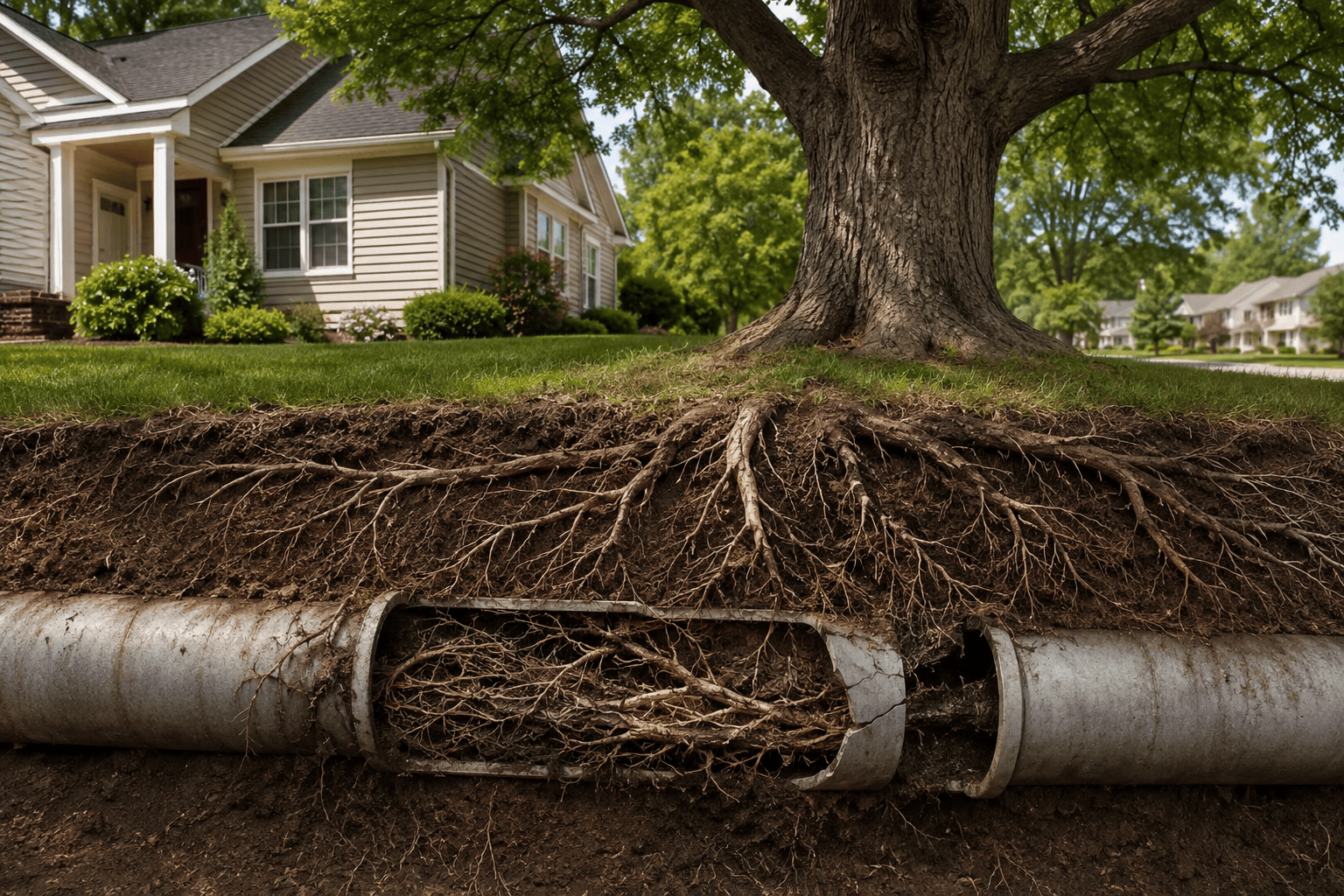
Tree Roots Damaging Your Sewer Line: Warning Signs Homeowners Miss
Tree roots follow moisture. An underground sewer line is an easy target: warm, wet, and full of nutrients. Roots enter through tiny cracks or joint separations that homeowners never see, grow inside the pipe, and eventually cause major blockages or full pipe collapse. The damage often costs thousands of dollars to repair, and in most cases, insurance will not pay for it.
This guide explains how to recognize the early warning signs, how root damage gets diagnosed and repaired, typical costs in San Mateo County, and how to prevent roots from reaching your sewer line in the first place. For the tree side of the equation – root pruning, stump and root management, or removal of a tree that is causing ongoing pipe damage – an ISA Certified Arborist (ours is #WE-12520A) can evaluate what can be done safely without killing the tree.
Early warning signs homeowners miss
Root intrusion almost always shows subtle symptoms months before a major blockage. Catch these early and you save thousands.
- Slow drains in multiple fixtures at once. If the bathtub and kitchen sink slow down in the same week, the problem is past the individual fixtures – somewhere in the main line.
- Recurring clogs that return within weeks or months of clearing, especially toilet backups.
- Gurgling from drains or toilets when other fixtures are used – indicates air trapped behind partial blockage.
- Sewage odors from drains, especially a sulfur or earthy smell, or foul smells coming from the yard itself.
- Unusually lush green patches in the yard above the sewer line – the wastewater is fertilizing the lawn.
- Sunken spots or soft, soggy ground along the line’s path.
- Foundation cracks or wall movement near where the line enters the house (severe cases).
If any two of these are happening, book a sewer camera inspection before the problem becomes a weekend emergency.
How root intrusion gets diagnosed
The gold standard is a sewer camera inspection: a plumber inserts a camera on a flexible rod into the cleanout and pushes it through the line, recording video. This confirms whether roots are present, where, and how much of the pipe is compromised. Cost is typically $150 to $400 for a standard residential line.
Supporting diagnostics include drain flow testing to identify the degree of blockage, and pipe material and age assessment (clay and concrete pipes installed before 1980 are much more vulnerable than modern PVC).
What happens if you ignore it
Untreated root intrusion progresses predictably:
- Partial blockage: slow drains, occasional backups
- Complete backup: wastewater into the house, typically at the lowest drain (shower or ground-floor toilet)
- Pipe cracks expand as roots thicken inside the pipe
- Full pipe collapse – roots literally crack the pipe apart from inside
- Soil contamination, foundation settling, and yard damage from continuous leakage
A $400 inspection that identifies the problem early prevents the $8,000 to $15,000 full replacement that comes later.
How to remove tree roots from sewer lines
Mechanical and hydro options
- Mechanical cutting – a rotating cutter head on a flexible shaft slices through roots inside the pipe. Fast and effective for established intrusion. $300 to $700.
- Hydro jetting – high-pressure water (up to 4,000 PSI) scours the pipe clean of roots, sediment, and grease. $400 to $900 for a standard residential line. Not for fragile or collapsing pipes.
Chemical root treatment
- Foaming root killers containing copper sulfate or metam-sodium are applied periodically to kill roots and slow regrowth. Professional products are stronger than consumer versions. $100 to $300 per treatment, usually annual.
Pipe repair or replacement
- Spot repair or sectional replacement – dig up and replace the damaged section. $1,500 to $4,500 per section.
- Trenchless pipe lining (CIPP) – inserts a resin-saturated liner into the existing pipe and cures it in place. Less yard disruption. $3,500 to $10,000 for a standard residential run.
- Full pipe replacement – excavate and replace the entire lateral from house to street. $5,000 to $20,000+ depending on length and access.
Arborist intervention on the tree itself
Sometimes the right answer is on the tree side: selective root pruning with a root barrier installed between tree and pipe, or in severe cases tree removal. A certified arborist can assess whether root pruning will destabilize the tree or whether barrier installation is feasible given the tree’s size and species.
Costs in San Mateo County
| Service | Typical cost | Notes |
|---|---|---|
| Sewer camera inspection | $150 – $400 | Diagnostic video of line |
| Root cutting (mechanical) | $300 – $700 | Clears existing root mass |
| Hydro jetting | $400 – $900 | High-pressure cleaning |
| Chemical root treatment (annual) | $100 – $300 | Prevents regrowth |
| Spot pipe repair | $1,500 – $4,500 | Excavate, replace section |
| Trenchless pipe lining | $3,500 – $10,000 | CIPP, minimal digging |
| Full line replacement | $5,000 – $20,000+ | Entire lateral replacement |
| Arborist root barrier installation | $600 – $2,500 | Physical barrier between tree and pipe |
Insurance coverage: usually no
Most California homeowner’s policies exclude gradual damage like root intrusion. Coverage is typically limited to sudden and accidental events. Root damage is considered a maintenance issue, not a covered peril.
Two possible exceptions:
- Sewer backup endorsement – optional add-on coverage for wastewater returning into the house. May cover cleanup and contents damage, not the pipe repair itself.
- Service line coverage – newer add-on that covers underground utility lines from the house to the curb. Available from some California insurers for $30 to $80 per year.
If you have mature trees near your sewer line and clay or cast iron pipes, service line coverage is one of the better-value add-ons available.
Who is responsible: you, the city, or your neighbor?
- Homeowner is responsible for the sewer lateral from house to city main, in almost all California jurisdictions.
- City is responsible for the main line under the street.
- Neighbors: if the offending tree is on a neighbor’s property but the damaged pipe is on yours, responsibility is usually still yours under the “branches and roots” rule. Proving negligence is possible but hard – usually you remove the roots and install a barrier yourself.
How to prevent root intrusion
- Never plant trees within 10 feet of sewer lines; ideally 20+ feet for large species. If you cannot avoid it, choose species with non-aggressive roots.
- Install root barriers when planting near existing lines – physical HDPE sheets 18 to 36 inches deep between tree and pipe.
- Annual sewer camera inspections for homes with mature trees within 25 feet of the line.
- Annual chemical root treatments if minor root activity is already present.
- Upgrade old clay or cast iron pipe to PVC when the opportunity arises – modern materials are far more root-resistant.
Frequently asked questions
1. How do I know if tree roots are in my sewer line?
The most reliable diagnostic is a sewer camera inspection – typically $150 to $400 for a standard residential line. The video confirms whether roots are present, where along the line, and how much of the pipe is compromised. Warning signs that justify booking an inspection: slow drains in multiple fixtures at once, recurring clogs that return after clearing, sewer odors from drains or yard, unusually lush green patches above the line, or soft spots in the ground along the line’s path. Any two of those warrant a professional look.
2. What dissolves tree roots in sewer lines?
Foaming root killers containing copper sulfate or metam-sodium are the standard chemical approach. Professional-grade products used by plumbers are significantly stronger than consumer hardware-store versions. These foam products expand to contact the roots all around the pipe interior, killing them over several days to weeks. Regrowth happens within months if the underlying intrusion point is not repaired, so chemical treatment is typically annual maintenance, not a one-time fix. Never use sulfuric acid or other aggressive drain chemicals for root removal – they damage pipe and create hazardous wastewater.
3. Does homeowner’s insurance cover tree root damage to sewer lines?
Usually no. Most California policies exclude gradual damage like root intrusion, treating it as a maintenance issue rather than a covered peril. Two add-ons can help: sewer backup endorsements (covers wastewater returning into the house, around $30 to $60 per year) and service line coverage (covers underground utility lines from house to curb, around $30 to $80 per year). If you have mature trees within 25 feet of your sewer line and older clay or cast iron pipe, service line coverage is one of the better insurance values available.
4. What happens if tree roots fully block the sewer line?
Wastewater starts backing up into the house, usually at the lowest drain first – a ground-floor shower or toilet. This is an emergency because raw sewage contains bacteria and viruses that require professional remediation. Do not use plumbing in the house until the blockage is cleared. Call a plumber for emergency service; most can dispatch within a few hours. Once the immediate blockage is cleared with mechanical cutting or hydro jetting, a camera inspection identifies the root cause and informs repair options.
5. Who is responsible if my neighbor’s tree roots damage my sewer line?
In California, usually you are responsible for repairs on your property even when the roots originated next door – the “branches and roots” rule treats crossed roots similarly to branches. Proving the neighbor’s negligence is possible but hard: you would need to show they knew the tree was causing specific, documented damage and failed to act. Most homeowners handle root removal and barrier installation themselves and pursue recovery only in extreme cases. A polite conversation with the neighbor about the issue – kept as a written record – is the right first step.
6. How can I prevent tree roots from damaging my sewer line?
Three approaches, in order of effectiveness: (1) avoid planting trees within 10 feet of sewer lines and choose non-aggressive species where proximity is unavoidable; (2) install physical HDPE root barriers 18 to 36 inches deep between tree and pipe; (3) annual preventive measures – camera inspection every 1 to 2 years for high-risk homes, annual foaming root killer treatment if minor intrusion is already present. If the pipe itself is 40+ year old clay or cast iron, upgrading to modern PVC during the next repair is the most durable solution.
7. Should I remove a tree that is damaging my sewer line?
Not necessarily. Many root intrusion problems can be solved without removing the tree through barrier installation, selective root pruning, and pipe repair. A certified arborist can evaluate whether root pruning will destabilize the tree given its species and size. Removal becomes the right answer when: the tree is already compromised structurally, root pruning severe enough to solve the pipe problem would kill the tree anyway, or the tree has minimal value relative to ongoing pipe repair costs. For a protected species in San Mateo County, removal requires a permit. Consult both an arborist and a plumber before making the call. Free consultations at (650) 355-1277.
8. How long does sewer line repair take?
Depends on the method. Hydro jetting or mechanical root cutting: a few hours, same day. Spot pipe repair: typically 1 day of digging and replacement, plus a day for the trench to be restored. Trenchless pipe lining (CIPP): 1 to 2 days, minimal yard disruption. Full pipe replacement: 2 to 5 days depending on length, access, and whether the line runs under hardscape. Permits from your city add a few days to a couple weeks upfront on larger jobs. Plan for a few days without full plumbing use on any significant repair.