
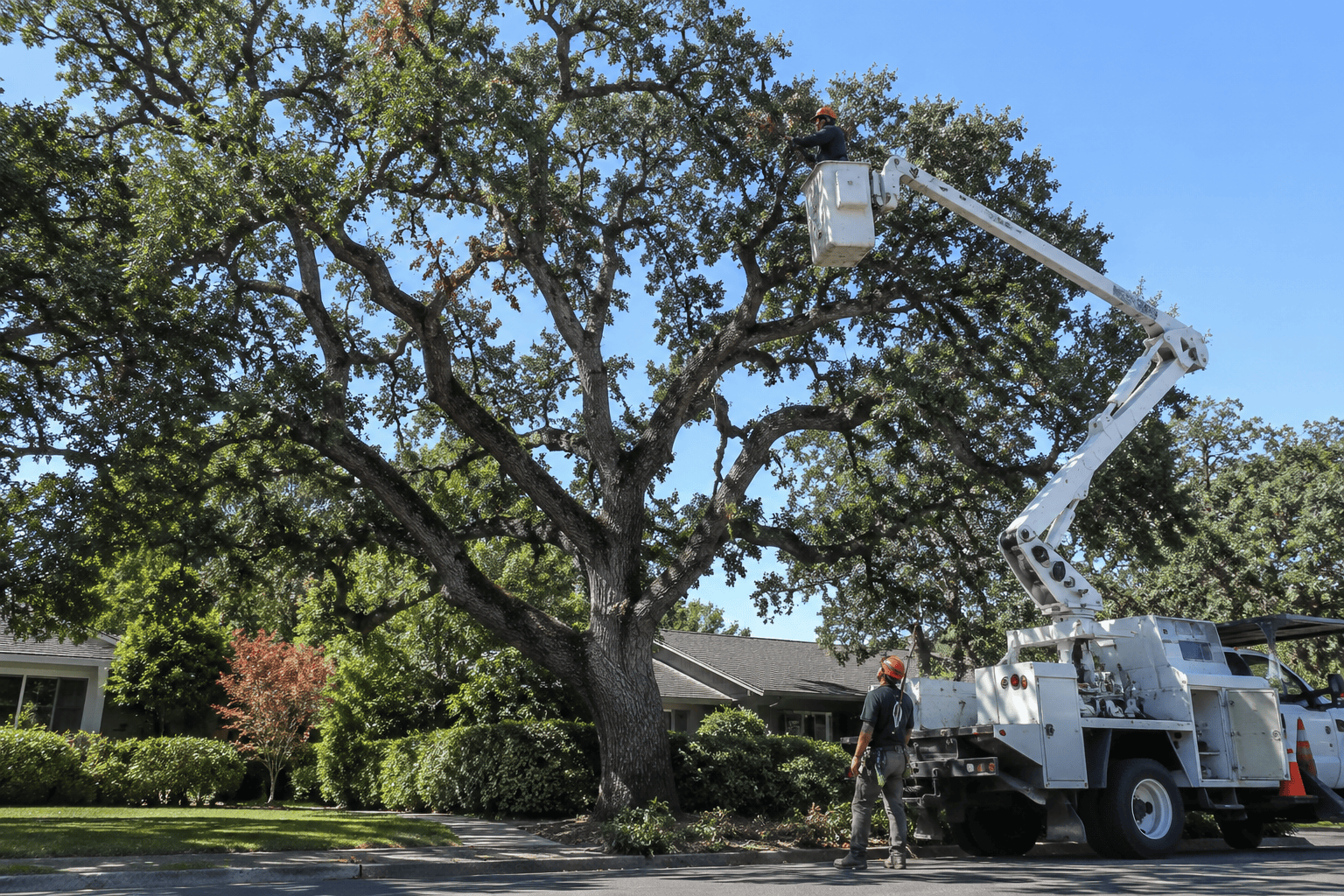
When NOT to Prune Oaks in California: Disease Risk and Safe Timing
For most tree species, timing of pruning is a matter of preference – do it when it is convenient and the tree will be fine. For California native oaks, timing is a matter of disease risk. Pruning oaks during the wrong season can introduce serious pathogens through fresh cuts, most notably Phytophthora ramorum (Sudden Oak Death) and beetle-borne fungal infections. The wrong cut at the wrong time can kill a tree that would otherwise have lived another century.
This guide explains when to avoid pruning oaks in California, why it matters, the safe pruning windows, and best practices for oak tree care on the Peninsula. For permit-regulated oak work in San Mateo County, Precision Tree Care’s ISA Certified Arborist (#WE-12520A) can handle the job safely and produce the documentation cities require.
The rule: do not prune oaks during the wet and warm seasons
For California oaks, the high-risk pruning period runs from approximately February through June – the combination of wet conditions and active beetle flight makes fresh cuts act as open doors for pathogens.
- February through April: Wet conditions, pathogen spore production peaks
- April through June: Beetle activity peaks, carrying fungal spores directly to fresh cuts
- Early summer: Still elevated risk until conditions dry thoroughly
Any cut during this window, even on a seemingly healthy tree, creates a pathway for infection. Emergency storm damage work may be unavoidable, but planned pruning should be deferred.
Why bad timing kills oaks
Fresh pruning cuts in oaks expose living sapwood. During wet, warm conditions:
- Pathogen spores are airborne at peak concentrations
- Wood-boring beetles actively seek fresh wounds to lay eggs
- Beetles carry pathogens on their bodies and deposit them directly on vulnerable tissue
- Wet wood provides ideal moisture for fungal and oomycete (water mold) infection
Sudden Oak Death, caused by Phytophthora ramorum, is the most publicized threat but not the only one. Other species-specific pathogens affect valley oak and black oak differently. Once established, none of these infections can be cured.
Safe pruning windows
For California oaks, the safe window runs from mid-July through late January – the dry, cool months when pathogen activity is lowest and beetle flight is reduced.
Best time: late summer through fall (mid-July to November)
- Pathogen spores at lowest atmospheric concentrations
- Beetle activity sharply reduced
- Dry conditions let cuts seal over before winter rains
- Leaves still on, so branches removed are visible and structural decisions are easier
Acceptable: winter dormancy (December to late January)
- Very low pathogen risk
- Structure is visible once leaves drop
- Cold temperatures slow any opportunistic infection
- Avoid pruning just before a major rain event – give cuts 48 hours to begin sealing
Exceptions: when pruning is unavoidable
There are legitimate exceptions to the seasonal rule:
- Storm damage requiring immediate removal of broken limbs – leaving torn wood exposed is worse than a clean cut
- Imminent hazard situations where a cracked or leaning limb threatens people or structures
- Dead wood removal – cuts on already-dead branches do not expose living tissue and are low-risk year-round
- Sanitation pruning – removing diseased branches to prevent further spread
In these cases, a certified arborist uses clean, sharp tools disinfected between each cut with a strong disinfectant (70 percent isopropyl alcohol or a fresh 10 percent bleach solution), makes minimal cuts, and avoids pruning during rain or in the hours immediately before rain.
Can you cut down oak trees in California?
Often, but only with a permit. California native oaks (coast live oak, valley oak, black oak, California white oak) are protected in nearly every San Mateo County jurisdiction. Removal typically requires:
- A written arborist report documenting condition and justification
- A city tree removal permit (typically $100 to $500)
- Replacement planting (often 1 to 5 new trees per tree removed)
- For heritage designations, additional senior-staff review
Unauthorized oak removal carries fines of $1,000 to $10,000+ per tree in most San Mateo County cities. See our guide to protected tree removal for specifics.
Costs: oak tree care
| Service | Typical cost | Notes |
|---|---|---|
| Oak tree fine pruning | $400 – $1,500 | Structural pruning, dead wood, proper timing |
| Emergency oak work | $500 – $2,500 | Storm damage, hazard removal |
| Sudden Oak Death inspection | $150 – $400 | Arborist diagnostic |
| Preventive phosphonate treatment | $150 – $500 per tree | Slows SOD progression |
| Oak removal (protected species) | $1,500 – $5,000+ | Includes permit documentation |
Oak tree health: year-round care
- Avoid summer irrigation near established native oaks – they evolved to go dry in summer and rot when watered
- Keep the root zone clear – do not compact soil with vehicles or heavy equipment
- Minimize wounds – no string trimmers near the bark, no tire impacts on roots
- Annual inspections in late summer for early detection of SOD and beetle damage
- Remove fallen leaves and branches from around affected trees – they can carry pathogen inoculum
Frequently asked questions
1. When is the safest time to prune oaks in California?
Mid-July through late January – the dry, cool window when pathogen activity is at its lowest and beetle flight is reduced. Peak-safe months are August through November. Winter dormancy (December and January) is also fine, though cuts should be made at least 48 hours before expected rain so the wound can begin sealing. Avoid February through June at all costs unless the work is genuinely unavoidable.
2. Can I trim oak trees in the summer?
Late summer, yes. Early summer (May and June), no. The transition happens as beetle activity declines and the rainy season ends – typically around mid-July in San Mateo County. Before that, fresh cuts are open doors for beetles carrying pathogens. If you must prune in early summer, limit work to dead branches only (no living-tissue exposure), use disinfected tools, and have a certified arborist supervise.
3. Why is pruning oaks at the wrong time so dangerous?
Fresh cuts during wet and warm conditions expose living sapwood when pathogen spores are airborne and wood-boring beetles are actively searching for wounds. Sudden Oak Death (Phytophthora ramorum) is the most publicized threat but not the only one. Once any of these pathogens establish, there is no cure – the tree declines over months to years. A single ill-timed cut can kill a century-old tree.
4. What if a storm breaks oak branches during the high-risk season?
Torn wood is worse than a clean cut. Have a certified arborist make clean cuts at the nearest structural point, disinfect tools between each cut, and avoid working in or just before rain. Emergency storm work during the high-risk season is justified, but should be minimal – only remove what is broken or immediately hazardous, not preventive work that can wait.
5. Can you cut down an oak tree on your own property in California?
In San Mateo County, usually only with a permit. Native oak species are protected in nearly every city and in unincorporated county areas. Unauthorized removal fines run $1,000 to $10,000 per tree. Legitimate reasons to remove (disease, hazard, unavoidable construction conflict) usually receive permits, but the process takes 2 to 6 weeks outside of imminent hazards. Budget the time.
6. Do I need an arborist report to prune or remove an oak?
For pruning, no, but it is still wise to use a certified arborist so the timing and techniques are correct. For removal of a protected oak, yes – most San Mateo County cities require a written arborist report with the permit application. The report documents tree condition, species, trunk diameter, any hazards, and the professional recommendation. Precision Tree Care’s certified arborist (ISA #WE-12520A) produces these routinely.
7. How do I protect my oaks from Sudden Oak Death?
Four practices: (1) avoid pruning during wet months; (2) keep the root zone clear of compaction and fill dirt; (3) do not irrigate near established native oaks in summer; (4) have preventive phosphonate treatment applied by a qualified arborist every 1 to 2 years in high-risk areas. Parts of the Peninsula, especially the southern coastal hills, have confirmed SOD presence. A targeted phosphonate program can slow disease progression significantly even on exposed trees.
8. How often should mature oaks be pruned?
Most mature California native oaks need pruning every 3 to 7 years at most – less frequently than many other species. They evolved in low-maintenance conditions and over-pruning stresses them. Typical work: removing dead wood, small structural corrections, clearance from roofs or power lines. Avoid topping and avoid removing more than 15 percent of live canopy at any single pruning. Free estimates at (650) 355-1277.